 Geri
Geri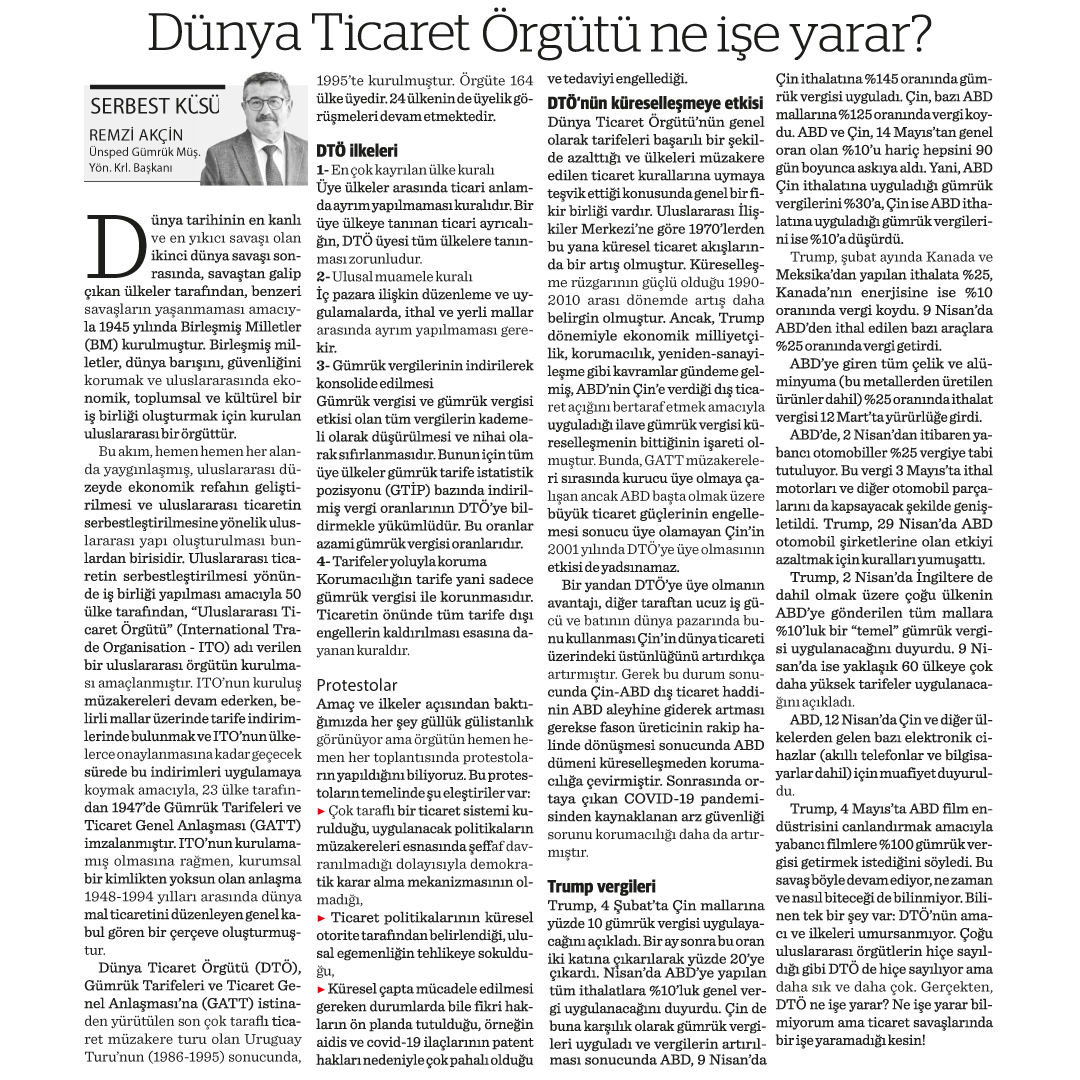
After the most destructive and deadliest conflict in history World War II the victorious nations established the United Nations (UN) in 1945 to prevent similar future wars. The UN was created as an international organization to preserve global peace and security while fostering economic, social, and cultural cooperation among nations.
This post-war movement extended into many areas, one of which was the creation of international structures aimed at enhancing global economic welfare and liberalizing international trade. To promote cooperation in trade liberalization, 50 countries proposed the establishment of an international organization called the International Trade Organization (ITO). While negotiations for the ITO were ongoing, 23 countries signed the General Agreement on Tariffs and Trade (GATT) in 1947 as an interim arrangement to reduce tariffs on certain goods and apply these reductions while awaiting ITO ratification. Although the ITO was never realized, GATT, lacking institutional identity, served from 1948 to 1994 as the de facto framework governing global trade.
The World Trade Organization (WTO) was founded in 1995 as a result of the Uruguay Round (1986–1995), the last multilateral trade negotiation conducted under GATT. Today, the WTO has 164 member countries, with accession negotiations ongoing for another 24 nations.
WTO PRINCIPLES
- Most-Favored-Nation (MFN) Principle
No discrimination among member states: Any trade advantage granted to one member must be extended to all other WTO members.
- National Treatment Principle
Imported and domestically produced goods must be treated equally in terms of laws, regulations, and taxes once they enter the domestic market.
- Reduction and Binding of Tariffs
Members commit to progressively reduce customs duties and related taxes, aiming for eventual elimination. Reduced rates must be reported to the WTO based on Harmonized System codes (HS codes), and these serve as the maximum permissible rates.
- Protection through Tariffs Only
Protectionist measures must rely solely on tariffs, not non-tariff barriers. All other trade obstacles must be eliminated.
PROTESTS
At first glance, the goals and principles of the WTO seem ideal. However, almost every WTO meeting is accompanied by protests. Critics raise the following concerns:
- A multilateral trade system has been created, but negotiations lack transparency, undermining democratic decision-making.
- Trade policies are shaped by a global authority, threatening national sovereignty.
- Even in global crises, intellectual property rights take precedence for example, AIDS and COVID-19 medications remained expensive and inaccessible due to patent protections, hindering treatment efforts.
WTO’S IMPACT ON GLOBALIZATION
There is broad consensus that the WTO has successfully reduced tariffs and encouraged countries to follow negotiated trade rules. According to the Center for International Relations, global trade flows have increased since the 1970s, particularly during the peak of globalization between 1990 and 2010.
However, during the Trump administration, economic nationalism, protectionism, and reindustrialization emerged as dominant trends. The additional tariffs imposed by the U.S. to counter its trade deficit with China signaled the decline of globalization. China, which had attempted to join GATT during its founding talks but was blocked by major powers like the U.S., finally joined the WTO in 2001 a milestone that further accelerated its dominance in global trade.
China’s competitive advantage, rooted in cheap labor and extensive outsourcing by Western companies, significantly shifted the trade balance in its favor. As the U.S. increasingly suffered from trade deficits and faced competition from its own outsourced production, it shifted course from globalization to protectionism. The COVID-19 pandemic and resulting supply chain vulnerabilities further fueled this trend.
THE TRUMP TARIFFS
Trump announced on February 4 that a 10% tariff would be imposed on Chinese goods. A month later, this rate was doubled to 20%. In April, a general 10% tariff was declared on all imports to the U.S. In retaliation, China imposed its own tariffs. By April 9, the U.S. imposed a 145% tariff on Chinese imports, and China responded with a 125% tariff on certain U.S. goods. On May 14, both sides agreed to suspend all but the 10% base tariffs for 90 days.
Trump also imposed:
- A 25% tariff on imports from Canada and Mexico, and a 10% tariff on Canadian energy.
- A 25% tariff on some vehicles imported into the U.S. on April 9.
- A 25% import tax on all steel and aluminum (including products made from them) as of March 12.
- A 25% tariff on foreign automobiles starting April 2, later extended to include parts and engines on May 3.
- A general 10% “base” tariff on all imports from most countries, including the UK, announced on April 2 and escalated on April 9 with higher tariffs for 60 countries.
- Exemptions for certain electronics, such as smartphones and computers, were announced on April 12.
- On May 4, Trump proposed a 100% tariff on foreign films to support the U.S. film industry.
This trade war continues with no clear end in sight. One thing is certain: the original goals and principles of the WTO are being ignored. Like many international organizations, the WTO is often disregarded more frequently and blatantly than others.
So really, what is the WTO for?
We may not know for sure, but one thing is clear: in trade wars, it serves no purpose.
- WHERE DID THE DIGITAL SERVICE TAX COME FROM?
- DECLARATIONS OF ORIGINS FROM SOUTH KOREA WILL BE REWIEVED
- BLOCKCHAIN
- WHAT IS SPECIALIZED CUSTOMS? WHAT IS ITS IMPORTANCE?
- What is the AEO Certificate?
- CORONAVIRUS (COVID-19) RELATED MEASURES TAKEN IN THE FIELD OF TRANSPORTATION AND FOREIGN TRADE
- COVID-19 MEASURES IN TERMS OF CUSTOMS AND FOREIGN TRADE
- WHAT IS ON-SITE CUSTOMS CLEARANCE IN IMPORTS?
- STAMP DUTY ON FUEL GIVEN TO SHIPS
- REGULATIONS RELATED TO HANDLING OPERATIONS
- Returned Goods
- COMMITMENT CLOSURE IN INTERNAL PROCESSING REGIME
- YYS AND OKS ADVANTAGES DISADVANTAGES
- LATEST SITUATION IN EXIMBANK SUPPORTS
- IMPORT OF USED OR REFURBISHED GOODS
- SPECIALIZED CUSTOMS APPLICATION
- THE RIGHT TO KUSAT
- CONSIGNMENT EXPORT
- FAST CARGO OPERATIONS
- MONTREAL CONVENTION ON CIVIL AIR TRANSPORT
- COMMITMENT CLOSURE IN OUTDOOR PROCESSING REGIME
- FUEL EXCISE TAX APPLICATIONS
- EFFECT OF PORT EXPENSES ON CUSTOMS VALUE
- CONTAINER TRANSACTIONS
- SUPPLIER DECLARATION
- QUOTA MANAGEMENT SYSTEM
- EXEMPTIONS AND EXCEPTIONS IN PRODUCT SAFETY INSPECTION
- PAN EUROPEAN ORIGIN CUMULATION SYSTEM
- BORDER TRADE
- TRIANGLE TRAFFIC IN DETERMINING PRODUCT ORIGIN
- RELATIONSHIP BETWEEN FOREIGN EXCHANGE LEGISLATION AND CUSTOMS PROCEDURES
- TEMPORARY STORAGE OF GOODS
- HOW DOES NATURAL GAS COME TO TURKEY?
- CHANGES MADE IN CUSTOMS PRACTICES AFTER COVID-19
- ADDITIONAL CUSTOMS DUTIES – SMUGGLING RISK DILEMMA
- Lump sum guarantee in warehouses
- FOREIGN TRADE TRENDS AFTER THE PANDEMIC
- GUARANTEE
- IS SUPERMAN HUMAN?
- IS A COMMITMENT REQUIRED?
- NEW IMPORT REGIME DECISION
- FAR EAST REGIONAL FREE TRADE AGREEMENT
- A LOOK AT THE ORIGIN OF GOODS IN THE NEW YEAR
- TEN PERCENT FREIGHT THREE PERCENT INSURANCE
- CONTAINER PROBLEM
- NEW CUSTOMS UNDERSTANDING
- ELECTRONIC LIQUIDATION
- EVALUATION OF EXPORT REGISTERED SALES WITHIN THE SCOPE OF EMPLOYMENT SUPPORT IN FREE ZONES
- CUSTOMS CONSULTANCY AND PROFESSIONAL ORGANIZATION
- WILL THE METAVERSE SEE US TOO?
- A SPECIAL FIELD OF EXPERTISE: CUSTOMS CONSULTANCY
- EFFECTS OF WAR ON TRANSPORTATION…
- WAR AND FOOD SECURITY…
- UKRAINE-Türkiye WAR AND TURKISH ECONOMY…
- CARBON FOOTPRINTS IN CUSTOMS TARIFF
- POSSIBLE EFFECTS OF RECESSION ON TURKEY...
- STATEMENTS NOT AVAILABLE IN THE BILGE SYSTEM
- FOOD SUPPLY SECURITY POLICY IN FOREIGN TRADE
- HOW WILL THINGS BE CARRIED OUT IN THE LOGISTICS INDUSTRY DURING STAGFLATION?
- A CHAOTIC YEAR: 2022
- 2022 AND AFTER IN TERMS OF LEGISLATION…
- THE LEARNING PROCESS OF THE POMODORO TECHNIQUE AND BEYOND
- THE IMPORTANCE OF DISASTER LOGISTICS
- UNMANAGED TIME IN THE MODERN WORLD
- NATURAL DISASTERS IN CUSTOMS LEGISLATION…
- "TRUST AND RESPONSIBILITY" INDICATOR IN PERSONAL DATA MANAGEMENT
- BIG DIGITAL STEPS TAKEN IN CUSTOMS APPLICATIONS…
- DIGITAL TRANSFORMATION IN CUSTOMS…
- 100 YEARS IN THE FIGHT AGAINST SMUGGLING
- CARBON REGULATION AT THE BORDER IS IN FORCE…
- TARGET OF THE BORDER CARBON REGULATION MECHANISM: INPUTS THAT CREATE CARBON LEAK…
- PURCHASING AND SUPPLY MANAGEMENT
- EXPECTATIONS IN CUSTOMS AND FOREIGN TRADE...
- One Window…
- 100TH ANNIVERSARY OF CUSTOMS…
- HOW DID I BECOME AN ASSISTANT CUSTOMS CONSULTANT?
- COURAGE TO CHANGE...
- WOMEN OF THE REPUBLIC OF TÜRKİYE WILL UNITE…
- HOW DO YOU IMPORT AN ITEM?
- DO ONLY BEES MAKE HONEY?
- GLOBAL SUPPLY CHAINS ARE IN A DIFFICULT COLUMN
- PSYCHOLOGICAL RESILANCE…
- EXPECTATIONS IN THE ECONOMY IN 2024…
- TURKEY CORRUPT BETWEEN GLOBALIZATION AND PROTECTION
- HOW IS THE DELIVERY OF AN ITEM TO THE IMPORTER PROVIDED?
- THE RISING AND RENEWING FACE OF EXPORT: e-EXPORT
- Q&A ON GLOBALIZATION…
- CAN A CITIZEN’S EXCUSE BE GREATER THAN HIS MISTAKE?
- DFIF: SUPPORT AND PRICE STABILITY FUND IMPLEMENTATION
- Made in EU Application: What Does It Mean for Türkiye?
- Hürmüz Boğazı’nın Derinliklerindeki Eşel Mobil Sistemi
- EU–Australia FTA: A Silent Wave of Competition for Türkiye
- Trade Agreement Between Türkiye and the Maldives: A New Framework for Commercial Cooperation
- Who Is Responsible For Delivering The Item?
- European Union Customs Reform 2026: A New EU Customs Code and Its Implications for Turkish Exporters
- Joint Statement from Türkiye and the United Kingdom on the Free Trade Agreement
- WTO publishes new edition of World Tariff Profiles
- Türkiye Achieved Successful Results in COST Participation
- Earth Overshoot Day Warning
- Support for E-Export from the Ministry of Commerce!
- 2023 Strategic Foresight Report: Sustainability and Prosperity at the Center of Europe's Open Strategic Autonomy
- New Cooperations Between Türkiye and United Arab Emirates
- Pazarkule Border Gate Opened
- WORLD INVESTMENT REPORT 2023
- A New Commercial Era Begins Between Türkiye and the EU
- Ministry of Commerce to Increase Export Support in 2024
- India and USA Mutually Resolve Six Trade Disputes in WTO
- World Economic Outlook 2023 July Report
- EU Prepares to Investigate Some Turkish-Origin Steel Products
- Digital Era in Foreign Trade
- The Rise of Africa as a Global Supply Chain Power: UNCTAD Report
- Ünsped Customs Consultancy Has Become The Solution Partner Of AEB in Türkiye.
- As of July 2023, "Safety Information Form" is being prepared at Ünsped Customs Consultancy.
- We have been at your service in International Customs and Logistics for 43 Years.
- Your Transactions are Easier at Customs with Fabric and Yarn Detail Information Forms
- ÜNSPED Customs Consultancy and Logistics Services Inc. Ranked 50th in the
- Green Check – Green Check Certification
- Supplier Sustainability
- UNCTAD Deniz Taşımacılığı Raporu 2021
- Dünya Ticaret Örgütü 2021 Raporu
- Transactions and Processes in Import Customs
- ETGB (Electronic Commerce Customs Declaration) Services
- Authorized Economic Operator Certificate (YYS)
- Foreign Trade Data for August 2023 Announced
- Step by Step Import and Export Business Processes
- Use of EORI Number by Carrier Companies in Transportation to the EU
- How to Become a Customs Consultant?
- Potential E-Export Market
- What is the Customs Tariff Schedule?
- Are Emerging Technologies Disruptive?
- Amazon Opens Its First Logistics Center in Türkiye
- Why is Customs Inspection Important?
- Penalty for Exorbitant Prices and Hoarding from the Ministry of Commerce!
- Transformation Project in 19 Logistics Centers
- The EU is Carrying Out Customs Reform.
- 5.5 Million Dollar Incentive for Exports from Foreign Trade Intelligence Centers
- The Private Financing Need of Developing Economies is Increasing
- Global Gateway Project from the EU in response to China's
- British Importer Will Buy Cat Litter from Türkiye
- Türkiye Increased Exports in 2023
- How Training and Consulting Can Accelerate Cross-Border Payments and Reduce Costs
- IMF Executive Board Approves Quota Increase
- From the President of Fisheries Subsidies
- Our company Ünsped Customs Consultancy is a member of UN Global Compact.
- UGM Chemistry Laboratory Accredited.
- Risk Management System
- More than an audit: Smart Inspector
- What Does Unsped Bring to You?
- Global Trade Consulting
- We were deemed worthy of the Sustainable Business Award with our Sustainable Agriculture Project
- We are at your service with our 3000 square meter Free Warehouse at Istanbul Airport for Your Export Transactions
- Logistics and Supply Chain Management
- UGM, ISO 27701 Personel Information Management System
- Compliance Management System
- Energy Management System
- What is Customer Work Portal (CWP)?
- 9 Advantages of Pre-Arrival Clearance
- The Need for Storage Space is Increasingly Increasing
- While Natural Gas Imports Decreased by 4.5 Percent, Oil Imports Increased
- ITF Publıshes 2023 Transportatıon Report
- Turkish Investment Fund Bill was Accepted
- Least Developed Countries Report Published
- Outstanding Collaboration Award from HUAWEI to ÜNSPED
- Goods Barometer Shows Trade Volumes Returning to Trend Amid High Uncertainty
- Central Bank Enters New Phase of Digital Currency Development
- Trade Deal to Connect Turkey to Europe Sıgned
- What is Perishable Food Transportation?
- How Developing Countries Can Keep Up with the AI-Driven Digital Economy
- International Trade and Green Hydrogen Supporting the Global Transition to a Low Carbon Economy
- Global Trade Patterns Become Geopolitical
- UNCTAD Report Reveals Untapped Potential of Trade in Climate Action
- How is Digitalization Changing Trade?
- Points to Consider in Fast Shipping Transactions
- The EU Abolishes Borders!
- Data Law Comes into Force in the EU
- Turkish Economy Continues to Grow!
- Home Buying Declines in High-Interest Rate Environment
- World Economic Forum 2024
- Foreign Direct Investment in Emerging Economies Declined
- Emerging Markets Lead Global Interest Rate Volatility
- LNG Imports Increase by 3.4 Percent in 2023
- Global Trade Disruptions Sound the Alarm!
- Global Economy Transitions to Soft Landing, But Risks Remain
- New Economic Forecasts from the European Union!
- Energy Demand Creates Pressure!
- The New Formation of the Digital Age 'Metaverse'
- Türkiye's Importance in Logistics Increases!
- EU Prepares its Digital Infrastructure for Tomorrow's World!
- Campaign for Equality, Diversity and Inclusion in Customs Launches
- Red Sea Attacks Disrupt Global Trade
- Goods Barometer Continues to Signal
- New Step in Free Trade Agreement!
- Accident at Kocaeli Evyap Port!
- Countries that Achieve Gender Equality Win!
- Global Trade Update from UNCTAD
- What Does the Future Hold for Global Trade?
- February Foreign Trade Data Announced
- Bulgaria and Romania Join the Schengen Area
- World Happiness Report Published
- Türkiye's Share of World Exports Increased!
- Saudi Arabia Supports Global Supply Chain Forum
- Central Bank Strengthening is a Must!
- WTO Asia-Pacific Conference of Heads of Customs Administrations Concluded
- The Effects of Trade Growth...
- 20th Anniversary of EU Enlargement
- What Will Trade Growth Look Like in 2024?
- Strong Cooperation Move from the WTO!
- What Does the Critical Mineral Boom Mean?
- Reflections of Global Crises on the Economy
- Geoeconomic Implications of Diversification in Foreign Trade
- Remarkable Visit from the United Nations!
- Global Economic Disruption and Changing Investment Models
- A Call from the UN Vice President for Trade and Development!
- 4th Data and Statistics Meeting from WTO
- Europe Must Increase Climate Action
- Africa holds the Key to Sustainable Energy...
- UN Trade and Development Organization Publishes 2023 Report
- EU Increases Support for Ukraine's Recovery
- 2024 World Investment Report
- Global Foreign Investors Dropped
- May Foreign Trade Data Opened
- IMF Optimistic on Sovereign Debt Restructuring
- EU Publishes Digital Transformation 2024 Report
- Global Trade Continues to Grow in the First Quarter of 2024
- 2024 DIGITAL ECONOMY REPORT
- Know Your EU Passenger Rights Before You Travel
- New Agreement from the World Customs Organization
- NEW PERSPECTIVES TO IMPROVE TRADE...
- Four Ways to Protect Consumers in Tourism
- WTO Secretary-General Addresses G7 Sector Stakeholders
- Tariffs on Critical Minerals
- New Sanctions on E-Commerce Sites From the Ministry!
- Traveling with Your Pets in Europe
- Artificial Intelligence Law Enacted in Europe
- Breaking Barriers: How non-tariff measures affect women in e-commerce
- Consumer Goods You Can Carry in Your Suitcase
- Europe Must Better Support Growth and Productivity
- New Decision on Contracts from the Ministry of Trade!
- Carbon Emissions from Artificial Intelligence and Crypto on the Rise
- Coping with the Growing Challenges of Public and External Debt
- Unlocking the Value of OSINT in Customs Enforcement
- Goods Barometer Above Trend
- UNCTAD’s Digital Economy Report 2024
- Dispute Panel Established Under the US Inflation Reduction Act
- EU Governments Face Pivotal Vote on Chinese EV Tariffs
- DDG Ellard spotlights role of the WTO, current priorities
- India, US Sign Pact to Cooperate on Critical Battery Mineral Supply Chains
- South Korea Economy Likely Returned to Growth in Q3: Reuters Poll
- US Exporters Race to Ship Soybeans as Looming Election Stokes Tariff Worries
- Turkmenistan: Trade Single Window Eases Transit, Powers Growth
- Indonesia's Exports, Imports Beat Forecasts, Trade Surplus Less Than Expected
- Leveraging Carbon Markets For Least Developed Countries
- G20 Economies Should Target Reforms to Boost Medium-Term Growth Prospects
- European Commission Calls for More Funding for the Electric Vehicle Sector
- Qatar to invest $1.3 billion in climate technology in the UK
- Goods Barometer Shows Moderate Trade Growth As Policy Uncertainty Looms
- EU Adapts Product Liability Rules to the Digital Age and Circular Economy
- Japan targets 40-50% power supply from renewable energy by 2040
- India extends duty-free import of yellow peas by two months till February 2025
- Customs Duty Increase From Syrıa's New Administration
- Davos 2025:Cooperation For The Smart Age
- Turkey- China Co-Operation : The Era Of Guaranteed Shopping İn Trade Begins
- Turkish Glass Industry Demands Protectıonısm Agaınst Far East Threat
- Foreign Trade Deficit In Steel Industry
- China Responds To Trump Adminstration's Additional Tariffs
- Automotive Sector Maintained Its Leadershıp In Exports
- Sharp Rise In Gold
- Germany Amıng The 9 Countries That Stand Out In Global Chip Production
- Eurozone Trade Surplus Reaches 15.5 Bıllıon Euros
- ECONOMIC DOWNTURN IN MEXICO’S 4TH QUARTER
- EURO CLIMBED AFTER GERMAN ELECTIONS
- Oil At Lowest Level Of The Year
- EU's Affordable Energy Action Plan Goal: €45 Billion In Savings
- Africa's Share In Grain Exports Appoaches 25 Percent
- THE COFFEE INDUSTRY IS IN CRISIS
- STATEMENT FROM THE MINISTRY OF TRADE: OUR LOGISTICS AND TRANSPORT SECTOR SERVICE EXPORT TARGET IS 48 BILLION DOLLARS
- 2050 OUTLOOK REPORT: GLOBAL NATURAL GAS PRODUCTION TO INCREASE BY 31 PER CENT
- Lımıted Quota Decision For Corn Imports
- Wheat Import Restrictions Ended
- SIGNIFICANT INCREASE IN GLOBAL RENEWABLE ENERGY CAPACITY IN 2020-2024
- TÜRKİYE-EU HIGH LEVEL ECONOMIC DIALOGUE IS RENEWED
- 34 PERCENT ADDITIONAL CUSTOMS TARIFF FROM CHINA TO THE USA
- MAJOR DECLINE IN GLOBAL COAL USE
- MULTIMODAL TRANSPORT APPLICATIONS ON TÜRKİYE EUROPE TRADE ROUTE WILL INCREASE TRADE VOLUME
- UEA LOWERED ITS GLOBAL OIL DEMAND GROWTH FORECAST
- UNCTAD ANNOUNCES THAT GLOBAL ECONOMIC GROWTH WILL SLOW TO 2.3 PER CENT
- Machinery exports totalled 6,6 Bıllıon Dolars In The First Quarter Of The Year
- Sharp Rıse In Commodıty Markets
- World Food Prıces Increased In Aprıl
- 100 Percent Tarıff On The Fılm Industry From Trump
- Tarıff Wave Capsızed Import Cargoes In The USA
- Important Agreement Between EU and UK
- European Union Revises Downward The 2025 Economic Growth Forecast
- Women Entrepreneurs Could Contrıbute $ 13 Trıllıon To The Global Economy
- Increase In Cargo And Contaıner Volume Carrıed In Chınese Ports
- Japan Looser Tıtle For The Fırst Tıme After 34 Years
- Trump's Travel Ban On 12 Countries And Restricted Visa Decision On 7 Countrıes In Effect
- Export Clımate Continues To Strengthen Moderately
- World Bank Announces: Foreıgn Investment Flows To Emergıng Economıes Hıt Theır Lowest Level
- We emphasized the importance of Women Effects in Management
- Composite Laboratory has Opened with the Cooperation of Boeing and Ege University
- We have participate in the panel titled New Opportunities in the new period, Izmir as the city of Free Zone
- We celebrated International Women's Day on 7 March with the Theme Sustainability and Women
- HalukÜndeğer High School Girls Volleyball Team is in High School Championship in Turkey
- Our Founding Chairman HalukÜndeğer Had participated in UGA Vocational Training
- We were all together at Göksu Marine
- We Came Together with 100. Year Trade Occupation High School Students
- Ünsped WomanLeadershipDevelopment Committee Was in Conference Themed Woman and Politics on Globalizing World at Aydın University
- Our Social Responsibility Committee Put A Smile To Our Children Face With The Ünsped FamilySupport
- Our Share Holder Yusuf Bulut Öztürk andOur Managers Met on Adana Lake Bank
- Our Social Responsibility Committee Was In “Festival Bakırköy”
- Woman and her place in Popular Culture
- Our Share Holder Yusuf Bulut Öztürk Attended to MÜSİAD 23. Ordinary Meeting of General Assembly
- Leadership Travel
- We came together with Students at Aydın University 9. Career Fair
- We Celebrated 23 April at Adalet Kindergarten School
- 2. Ünsped Children Festival Drawing and Poem Competition Concluded
- We Are Together To Increase The Autism Awareness
- IDEF'15 12.International Defense Industry Expo Took Place
- Our Seminar About Terms of Delivery and Payment took place
- Our Management Team held their second meeting
- Our Social Responsibility Team was at the Sunay Akın Istanbul Toy Museum
- Rising Power of the Women in the Business Life
- We gave training themed Free Zone Legislation and Applications in Aegean Free Zone
- We Participated in Win - Win Themed Seminar of DEİK in Turkish Customs Association
- Management Team Realized Their Third Meeting with the Theme “What are the Customers Expecting from Us?”
- We Participated in Turkish Business World Dialogue Network Activity
- ThisTime the Agenda was the Comparison of FCPA, UK Bribery Act and Brazil Clean Company Act in the Khedive Meetings of TEID
- We Participated to the 2nd International Defense Industry New Investments and Innovation Conference
- Social Responsibility Committee of Our Company Visited Hüsnü Arık Special Care Center of Paraplegia Association in GÜRPINAR
- We Commemorated TheGreat Leader Atatürk in the 77th Anniversary of His Death
- Adjustment Programs Management Periods in Inter-corporate Communication
- Being A Woman in Business Life and Success
- “Women and Technology” Themed Seminar Attracted Attention
- We Explained Ünsped Gümrük Müşavirliği to the Students from Kültür
- Our UPS Sports School Coordinator was in Fair Play Commissions Meeting in Azerbaijan
- We Evaluated the Year 2015 with the “We Share” Motto
- We Celebrated the New Year Together
- “Ethics and Exploitation” Seminar was Carried Out in our Noon Talk
- Legal Awareness of Ethical Work Approach training was Carried out
- Reverse Mentorship Practice Continues
- With the 4th Management Team Meeting, the Managers Shared Information
- Children Become Happy with 124 Children 124 Wishes Project
- Social Responsibility Committee Made Dental Screening to Kindergarteners
- 3 Wheelchairs are Donated
- We were in Polonezköy for a Pleasant Breakfast
- We Celebrated 8th of March International Women’s Day with Enthusiasm
- When It Comes To Women Panel Gathered Women Who Create Awareness In The Society
- We organized Farewell Dinner For Our Regional Operation Manager
- The 2nd Trip of We are a team was organized in Edirne
- We Said One Cake One Donation
- Under the Guidance of Ünsped Social Responsibility Committee, Adalet Kindergarten Kids Started Horse-Riding and Swimming Courses
- We talked about the Effects of Advancing Technology to our Business Life
- On the Children's Festival Everbody Had Lots of Fun
- We listened to the thema Healthy Life and Nutrition from Dietetician Taylan Kümeli
- Mr. Kenan Yavuz, who is a Member of Board of Socar, which is a Governmental Oil Company of Azerbaijan was our guest in UGA Midday Talk
- We Were In The 10th Career Fair
- Our Aegean Regional Director Organized the Traditional Breakfast
- Ünsped Development Academy UGA is Established
- Our Social Responsibility Committee Is Spreading to Anatolia
- We Celebrated May 19th Commemoration of Atatürk Youth and Sports Day with First Step Walk With Youth Named Organization
- 5.Meeting of Management Team was performed
- We were climbing Bolkar Mountains in the 90th year of our Republic
- We celebrated Father's Day with our Distinguished Guest
- We Were Informed About Perspective Of Y Generation to Business Life
- We Discussed The Importance of Subconscious in the Communication Between the Generations and Its Necessity for Success in Team Work
- We Made a Sweet Presentation With Private Chef Pınar İshakoğlu
- We Talked About How To Be A Strong Team With Dear Turgay Kıran
- We had a Happy Day in Ağva with 'We Are A Team' Trip
- We Listened To The Tale of The Success That Comes With Determination from the Turkish Female Entrepreneurs Who are Nominated for Nobel Prize
- We Listened to The Subject of Adding Value and Productivity from the Composer that Adds Value to Turkish Music Mr. Suat SUNA
- Another Victory from the Stars of UPS…
- We Talked About Success in Business Life with Dear Dr. Rüştü BOZKURT
- Our Motto in 6th Management Team Meeting was to Have a Good Communication in all of Our Processes and the Importance of Well-Measuring of Our Processes
- Dear FatmaAydoğdu Explained the Secret for Success ad her Life, her Work and Loving People
- Our Ünsped Social responsibility Committee was Deemed Worthy of the 2nd International Corporate Social Responsibility Award with A Handful of Sky Project
- We Carried Our Our 35th Traditional End of The Year Evaluation Meeting with We are Measuring, Planning, Sharing Theme
- We Thanked Everyone who Contributed in Our 35th Traditional End of Year Evaluation Meeting
- Plaque from Kızılay...
- Our New Year Celebrations Took Place Simultaneously in Our İzmir and Erenköy Branches
- The First of Current Legislation Briefing was realized
- 'We Are A Team' Trip was realized to An Old Fishing Village of Anadoluhisarı District
- Our Powerpoint Training used in Preparing Efficient Presentation was realized
- Attention was drawn to Communication Rules Training and Rules of Good Manners in Business Life
- Ünsped Company Celebrated its 33th year
- ''Importance of Permanency and Loyalty'' was mentioned for the Success in Business Life
- Our 7th Management Team Meeting was realized
- Ünsped Customs Consultancy did Final Situation Briefing in Authorized Obligator Status
- Our Seminar on Transformations in Science and Human Mentality was realized
- We Have Been Informed about the Economy and Exports in 2017 by Dr. Bader Arslan's Presentation
- Dreams of our Children Revived with our 2nd Traditional Children Festival
- Our Seminar with the topic of "Origin" was realized with the Cooperation of UDA and Customs Trade Specialists Association
- We listened the topic of 'Happiness at Work'' from LC Waikiki Company's Employee Relations and Internal Communication Manager Ms. Ayşe Eralp
- Young Generation Leadership Development Committee's From Generation to Generation Projects are continuing
- We are continuing to have the Training of "Developing the Communication Skills and Recognizing the Human''
- IDEF 2017 13th Defense - Industry Fair was realized in Tüyap between the dates of 9-12 May 2017
- The “Women in Business” Breakfast Organization of the Ünsped Female Entrepreneurs Committee
- Our Aegean Region Directorate Arranged Traditional Breakfast Organization
- Young Generation Development Committee realized the Project of "We are Visiting Every Era's Nostalgia, Hababam (The Dunce) Class''
- Our Traditional First Step Walk with the Youngsters Organization was realized in Florya Atatürk Forest
- The Professional Development Trainings 2014 within the Scope of the Ünsped Gelişim Akademisi (Unsped Development Academy) Have Started
- In our Enlightenment Meetings, We Hosted the Chairman and Board of Directors of Fashion and Ready Wear Federation
- In Enlightenment Meetings, we discussed the Subject of "Education and Common Reflections of Generation Differences in Business Life and General Overview to Generations"
- In our Enlightenment Meetings, We Drew Attention to "Can Robots Take Our Jobs from Us? A Look at to Our Day's Reality from Science-fiction World" Theme
- We Realized Acquaintance Meeting of 2017-2018 Year with Our Interns
- Cooperation Protocol was signed between Altınbaş University and Ünsped Customs Consultancy
- In Our Enlightenment Meetings, We Hosted Tohum Turkey Autism Early Diagnosis and Education Foundation General Manager Dear Betül Selcen Özer
- Our Seminar with the Subject of "Legal Awareness of Ethical Business Approach" was realized
- Zahide Demir was our guest with a presentation about an inspector's story Within the Scope of Illumination Meetings
- The Most Important Carrier of Cultures and Generations is the Language was the Theme of our Illumination Meeting
- Our Enlightenment Meeting with the Theme of "Child Training of the Mother in Career Journey'' was realized
- The Integration of Aviation with Customs Clearance and Logistics Panel in Realized Today in the Haliç Congress Centre
- Importance of Leadership in Happiness and Employee Communication Themed our Lighting Meeting was taken place”
- Young Generation Leadership DevelopmentCommittee Met with the Newest of the Business World: Z generation Fall TermInterns
- Esteemed Dr. Nermin Yavlal was our guest with her Presentations Titled “Importance of Women and Family in the Values Education “Within the Scope of Illumination Meetings
- We Talked Over “Women’s Hand in Economy” with Assoc. Prof. Dr. Banu KAVAKLI BİRDAL, Head of Altınbaş University Sociology Department and Manager of Institute of Social Sciences
- Members of the Ünsped Female Entrepreneurs Committee; are Included into the KAGIDER, UPS and TurkishWIN Female Leadership Platform
- We discussed with Retired Colonel - Specialist Psychologist Aysel Bilgin; Is There a Social Gender Inequality?
- Foreign Trade Officer from Turkish Exporters Assembly Mrs Nazan ÖZTÜRK was our guest at 'Origin' Themed Information Seminar
- Within the scope of Enlightening Meetings Şahinler Holding Chairman Mr. Kemal Şahin was Speaker in Our Seminar on Employee Communication and Spirit of Doing Business Together
- Led by Ünsped Employee Communication and Workplace Happiness and under Committee Enlighting Meetings, On Wednesday, 01.11.2017, between 12:30 and 13:30 hours, at the UGM, MHU Conference Hall, Retired Colonel Mr. Yusuf Bilgin was our guest to work on 'The
- We handled “the Golden Rule in Communication: Honesty and Rhetoric” Subject with Self-Improvement Instructor Dear Ümit Hakan BOZKURT
- We took place in Turkish Cement Manufacturers' Association (TCMB) Seminar on the Transboundary Movement of Wastes
- We Came Together With the Officers of Çukurova District Office
- We Have Attended the Seminary of the Gaziantep Chamber of Freelance Accountants and Financial Consultants...
- We Performed Our Project Named As "Magic Touch" at Köşeli Mosque in Zeytinburnu District.
- The Awards are Delivered to Our Winner Personnel of the ‘I Have An Idea’ Project
- We Performed Our Project Named As "Patient Angels" at Private Avrupa Şafak Hospital
- Everything in the World is the Vestige of Women. Mustafa Kemal Atatürk
- Mr. Münteha ADALI, CEO of Güvensan Building Maintenance Services Company was our guest to talk about the subject 'Once Upon A Time We Also Were Y Generation'
- Brand Course Protocol was signed between Altınbaş University and Ünsped Customs Brokerage
- Our Company Continues to Invest in Our Executives with the Action with the Saturday’s Meeting
- ÜNSPED Gümrük Müşavirliği ve Lojistik Hizmetleri A.Ş. carried out “Foreign Trade Overview” Themed Seminar with the cooperation of Ünsped Development Academy UGA and AHK
- We Conducted our 36th Traditional End of Year Meeting with “We are Assessing and Sharing” Theme
- Tomorrow We Will Be Better Than Yesterday
- Our Employees Gathered in our Headquarters on 06 January 2018 Saturday for the Business Development Presentation Training
- Cooperation of Transparency International / Private Sector
- This Time, in our Enlightenment Meetings, We Talked About “The Law for the Protection of Personal Data”
- We Conducted “Meet and Greet with Breakfast” Activity with our Scholarship Students
- “Leadership Workshop Trainings” were conducted with the Leadership of ÜNSPED Development Academy
- Our Innovations about the Legislation and Authorized Economic Operator System Overview Themed Seminar was Performed
- Our Aids To The Yedikule Animal Shelter are Continuing...
- In order to deal with the subject of 'Women and Family in Turkish Civil Law', Prof. Dr. Şükran ŞIPKA, Altınbaş University Faculty of Law Teaching Member, was our guest.
- On the initiative of the Employee Communication and Workplace Happiness Committee, 6th "We Are A Team" Trip was realized.
- Employee Communication and Workplace Happiness Committee Attention to "Empathy for Effective Communication"
- The Unsped Children’s Feast on April 19th
- Employee Communication and Workplace Happiness Committee Attention to the "Establishing the Foundation of Healthy Communication, Love, Respect and Sincerity"
- Under the Leadership of Women Leadership Development Committee, within the Scope of Kadın Enlightenment Meetings, Ms. Evrim TIMUR was our Guest to Talk About “Women in Design Services Sector”
- The Ünsped Women’s Entrepreneur Association was in the Necmi Hoşver Primary School in Düzce at the 23rd of April
- Our Mission is to Provide Fast, Competitive and Customer-Expectant Services with Law and Legislation with a Dynamic Team Study
- We have received our plaquet named "Thank You for Adding +1 Life to Our Life"
- Visa Examination of Custom Regulations and Operations Course Within the Scope of Brand Course Project have realized.
- In the scope of our Project ' Write your idea and earn the reward ' the prizes continue to award their owners…
- We reward our employees for their contribution to the company
- The Ünsped Women’s Entrepreneur Association was invited to the 2. Activitu of the “Women’s Leadership Plattform”…
- Mr. Ataman ÖZBAY became our guest within the scope of the Disclosure Meetings under the Guidance of the Woman Leadership Development Committee
- Life Coach, Life Repairer Ms. Dilek Mirza ÇELİK became our guest within the Scope of the Disclosure Meetings under Guidance of the Woman Leadership Development Committee
- The Management of Female Brain and Emotions in Business Life Seminar was Held
- We are Entitled to Receive Etika 2017/ Turkish Ethics Award Granted by EDMER - Ethical Values Center Association
- Our "Each Success has Its Own Story" Themed Seminar was Held on 09 May 2018 within the Scope of Enlightenment Meetings
- The Tukish People has such mothers, the Great Men of the Era were raised by such mothers. MUSTAFA KEMAL ATATÜRK
- Disability is in Hearts and Thoughts
- Our founder president Haluk ÜNDEĞER and the Ünsped Women’s Entrepreneur Association met...
- With Thanks to the Strongest Women, Our Mothers...
- Traditional Welcome Summer Breakfeast was realized at the “ Tarihi Asansör” - “Historical Elevator” location in İzmir…
- We Handed out Turkish Donut and Wished that ıt would Lead to Goodness
- Happy and Highly Devoted Employees are The Voluntary Delegates of The Company
- We Were Together This Year in our Traditional Iftar Organization Organized Jointly by Bağcılar Municipality and Our Company
- We were Together Again in the Traditional Iftar Organization that was Co-organized by Bağcılar Municipality and our Company
- We celebrated the Wold Handicapped Week
- We Have Handled the Topic “the Laws of Efficient Communication according to the Meaning of Life and Relations” under Leadership of the Committee of Employee Communications and Happiness at the Workplace
- We Have Handled the Topic of “the Literary Language in Employee Communications” under Leadership of our Committee of Employee Communications and Happiness at the Workplace in our Disclosure Meeting
- Our Seminar Themed “Our Fathers, the Veterans of Our Country” has Actualized within the Scope of the Disclosure Meetings under Leadership of the Committee of Employee Communications and Happiness at the Workplace
- We have celebrated the 3rd Traditional Ünsped Summer Festival, we said hello to Summer at Naturköy...
- We Have Handled the Topic of the Leadership Purse of a Business Woman together with Mrs. Aylin SATUN OLSUN, the Managing Partner of ASO Company –the General Secretary of PWN Istanbul
- We participated to Networking Drink Activity organized by Turkish Belgium-Luxemburg Trade Association
- Our Committee on Employee Communication and Happiness at the Workplace has Celebrated the Ramadan Feast of All our Employees
- Our Committee on Employee Communication and Happiness at the Workplace has Celebrated the Father’s Day
- Turkish American Businessmen Association has realized the 28th ordinary general assembly meeting on 30th May 2014...
- Authorized Obligatory Certificate Delivered to Yazaki Otomotiv Yan San. ve Tic. A.Ş.
- 2018-2019 Yusuf Bulut ÖZTÜRK Met with Students Who Will Have Their Internship at Our Company in Their Education Period
- Social Media Education in the scope of UGA of Unsped Development Academy
- Notre séminaire sur la législation a été réalisé grâce à la coopération d’UGM et la Chambre du Commerce et de l’Industrie Germano-Turque
- The Import Department came together at lunch with our Electronics Group
- Hosted by the Development Committee for Women's Leadership, we have hosted Mrs. Özlem ABACI who gave years to Opera in our company
- Ünsped Customs Consultancy Realized the 6th Region Formation
- ÜNSPED Development Academy UGA's Preparatory Courses for Examination for Customs Officer (GMY) Exam Weekends and Weekends Continues
- Our Seminar on
- Customer Seminar on Customs Practices Regarding New Additional Financial Liability and Additional Customs Taxes
- Our Social Media Training was completed in the Leadership of Ünsped Development Academy UGA
- Our company was invited at the 3rd“Women’s Leadership of the Plattform”Women’s Entrepreneur Association
- Our Seminar with the subject of ''25 Million Creative Generation Shall Determine the Future of Turkey. They are; YOUNG, DYNAMIC, CREATIVE AND FREE GENERATION!
- Our Employee Communication and Workplace Happiness Committee Celebrated the Feast of Sacrifice of all our Employees
- Our Meeting with the subject of Key of Success and Happiness in Business and Social Life; Emotional Intelligence was Realized
- Customs Practices on Additional Financial Liabilities and Additional Customs Taxes trainings were held in the Period of 04-06-11 September 2018
- Our
- Under the guidance of Young Generations Development Committee, our Clarification meeting named as
- The visit of the Semiha Şakir Nursinghome by the Ünsped the Woman’s Entrepreneur Association
- Our Training themed "Origin, Preferential-Non-Preferential Origin, Customs Union, Free Trade Agreements, Cumulation of Origin" was pereformed
- Our Seminar themed
- We were in Istanbul Airshow
- We share management, act as a whole
- The Opening of the Painting Exhibition with the Theme of Happiness
- Our Seminar on "Documents and Terms Used in Foreign Trade" was Held
- We were in Ankara Logistics Summit
- Our First Aid Training Took Place
- UGM Emergency and Evacuation Drill
- UGM Shareholders Meeting
- Our training was performed in cooperation with TAYSAD - Association of Automotive Parts and Components Manufacturers and Unsped Development Academy (UGA)
- Customs Implementations for New Period Additional Financial Liability and Additional Customs Duty Seminar
- We as Ünsped Gümrük Müşavirliği ve Lojistik Hizmetleri A.Ş. were in the Export Academy Training Program
- Our Youth Summit Themed
- Teachers' Day in ÜNSPED
- Our "Communication and Emotional Intelligence" themed Training Took Place
- Our "Management and Leadership" themed Trainings Took Place
- The Board of the Ünsped Woman’s Entrepreneurship Association visited the Necmi Hoşver Primary School in Düzce at the 27th September
- Inward Processing Regime themed Workshop Took Place
- Our 37th Traditional End of Year Evaluation Meeting Took Place with
- Business Summit within the Scope of Customs and Foreing Trade Specialty Certificate Program in ÜNSPED
- Our Shareholder Mr. Yusuf Bulut ÖZTÜRK came together with our Young Generation Employees who consist of Valedictorians
- Our seminar titled “Customs Legislation and Practices” has been held with the collaboration of the UGM and Kocaeli Chamber of Industry.
- Let's Write a New Success Story in 2019; Many Beautiful and Happy years Together
- Our First Customs Legislation Training was Performed
- Our Seminar Themed "2019 Import Regime Decisions and Changing Foreign Trade Practices" was Held
- We Made Our First Visit to Kurtköy Forest with Our Social Responsibility Committee
- Brand Course Project has Started
- Our Exhibition Themed "OBJECTIVE COMMUNICATION" Has Been Opened
- Customs Clearance Before Arrival Themed Seminar Took Place
- We were in XII. Corporate Management Summit: Change Balance Value Summit
- Plastic Cap Campaign Project - ÜNSPED Social Responsibility Committee
- 2018 Çukurova Seniority Plaque and Certificate Presentation Took Place
- Our Enlightenment Meeting on 'Empathy for Barrier-Free Success' was Held
- We made our Second Visit to Kurtköy Forest with Our Social Responsibility Committee
- 2018 Seniority Plaques and Certificates are Presented to Their Holders in our Headquarters
- We Commemorated March 8 International Women's Day with
- We were in Chamber of Industry on 07 March 2019
- We were in Aegean Regional Directorate with our
- Our Most Valuable Source is; Our Employees
- We Visited Arpaçsakarlar Elementary School within the Scope of
- We Celebrated 20 March World Happiness Day with
- We were in the organization of women in Social Entrepreneurship and Management
- We were at 'Logistics Talks' at İstanbul Gelişim University
- Sharing Management, We Act as a Whole
- Our employees are the essence of our company
- Our Seminar on the Place and Importance of Teamwork in Communication has been realized
- Our Training Cooperation with the Kocaeli Chamber of Industry
- Young Generation Leadership Development Committee was at the Eser Yenenler Show
- Training on Standard Management System
- Our shareholder Yusuf Bulut Öztürk has met with Aegean Regional Customer Representative
- We hosted Mr. Cüneyt SEZGİN, Board Member of Garanti Bank A.Ş. within the scope of Lighting Meetings
- Training on problem solving and time management, emphasis on priority tasks has ben realized
- We have given the Seniority Certificates and Certificates to our Kocaeli Region Employees
- ÜNSPED Social Responsibility Committee Supported My Village Project
- Employee Communication and Workplace Happiness Committee Organized a Hello to Summer Trip in Edirne
- ÜNSPED Social Responsibility Committee Becomes a Partner in the Enthusiasm of Children
- Trainings on TTS (Demand Tracking System) and IVI (Return and Dispute) System were given to our employees on 24-25 April 2019
- We were at Istanbul Fair of Career and Employment on 24-25 April 2019
- Training on Negotiation and Conflict Skills has been realized
- All our employees makes us become stronger with their works
- Ünsped Employee Communication and Workplace Happiness Committee Commences Ramadan Preparations
- Our "Origin" Themed Training Took Place on 04 May 2019
- We Listened the
- Mothers Grow the Seeds
- The second seminar of customs legislation and practices has been performed
- We Congratulate Our Employee Ms. Şeyda CANBOLAT for her Success in Hearing Impaired Turkish Championship
- We Listened the Topic of "Being Women in Movie Cinema Industry" from the Owner of Kadıköy Cinema Ms. Funda KOCADAĞ
- Our Young Generation Leadership Development Committee celebrated 19th May with the theme of
- We listened to the issue of “Being a woman in the energy sector
- “Each book is a window opened to the world”
- We are at the 8.International Logitrans Transport Logistics Fair
- We listened to issue of "Being a woman in the communication sector" from author-career consultant-Mastercamp training platform founder Ms. Zühal GÜRÇİMEN
- Our Fathers are Our Supports
- Our Employees were in Canoe Activity under the Leadership of Young Generation Leadership Development Committee
- We Unveiled our UGL Temporary Storage Yard and UGM Customs Office
- Ankara Chamber of Industry President Visited our Company
- Students who will undergo internship in our company and our Company Partner Yusuf Bulut ÖZTÜRK came together
- Our South Korea FTA and Suspension System Training was Held
- Ciner Holding Interns Took Their Vocational Development Trainings in our Company
- We gave Training on
- We Were on Lunch with Our Newly Recruited Personnel
- We Made Our Courtesy Visits
- UGM Awarded the International Fair Play Committee's Fair Play of the Year Award 2018
- We listened to
- Our disclosure meeting on “Fair Play in business and sport” took place
- Our Blockchain Meeting Took Place
- Our Professional Development Training Took Place on 03-04 October 2019
- 12th Management Team Meeting was held on 28.09.2019
- On-Going Business Development Meeting with the Customers… This time, we meet at our Head Office.
- Our Professional Development Trainings Were Held on 03-04 October 2019
- We Visited Eskisehir Chamber of Industry
- We took our place at the conference on industrial growth in the National Defense and aerospace industry held with international cooperation on October 10-11, 2019
- On-Going Seminars in Collaboration with Kocaeli Camber of Industry
- Our Company Took Part in UGM Fair Play Universities Caravan Project
- We Took Our Place at the 6th World Automotive Conference
- 11th Traditional Year-End Meeting is held
- Our 2019 UGM partners meeting took place
- Our seminar on examination of current legislation amendments and issues in 2020 perspective was held
- On 26.10.2019 Ünsped customs brokerage board and committee directors were convened under the chairmanship of our company partner Yusuf Bulut Öztürk.
- We Celebrated the 96th Anniversary of our Republic
- Our seminar on “Draft Law Proposal on Amendments to the Origin Legislation and Customs Law” was held
- We Met With The Workers on the Vehicle and Courier Department
- As ÜNSPED, we held the eighth meeting of our Customer Advisory Board.
- Gaziantep Economy Investment and Foreign Trade Meeting
- Our Earthquake, Emergency and Evacuation Drills
- Seminar on Legislation of Origin, Additional Customs Duty and Additional Financial Liability Applications
- Dilovası Machinery Specialized Organized Industrial Zone Association of Machinery Manufacturers (MIB) and our company in cooperation with our training took place
- We talked about 2020 with our industrialists in Adana.
- We continue to realize our Unsped Anadolu Foreign Trade Meetings.
- We celebrated Teacher's Day in ÜNSPED
- Business Cup 2019 Fall Season The Most Gentlemen Team Award
- We Hosted Bekir Sütcü, Chairman of the Board of Directors of Adana Hacı Sabancı Organized Industrial Zone, in the BloombergHT Program
- Our First Business Development Meeting Took Place
- We attended TÜSİAD High Consultation Board Cocktail
- Ms. Mine EKİNCİ, founder of KODA, Village Schools Association, was the guest of our women's Leadership Development Committee
- We performed Incoterms 2020 Information Seminar in Aegean Exporters Union
- We performed 2nd of our business development meetings with conference participation from regions
- Our Company was Awarded 2019 Transparency Awards
- The president of the Turkish Plastics Industry Research and Development and Education Foundation (PAGEV) visited our company
- Occupational Health and Safety Training Continues
- Our Professional Development Training Continues
- We attended the Buyernetwok
- President of the Association of Defense Industry Manufacturers Visited Our Company
- ''Emergency Evacuation Drill'' was performed in our Aegean Regional Directorate
- Our Seminar on "Women in Environment and Sustainability" was Held
- Our Anatolian meetings has been continuing: We are in Mersin
- ÜNSPED Anatolian Meetings: We are in İzmir
- We held our 38th Traditional Year-End Assessment Meeting with the Theme of
- We were at the Service Exporters Meeting and 2018 HIB Award Ceremony
- Each New Period Starts with New Opportunities, New Hopes, New Plans: We Celebrated the New Year with All of Our Employees
- Our Customs Legislation Amendments Training Took Place on 7 and 8 January 2020
- We Talked about the Topic of
- Customs Brokerage Minimum Price Tariff Training Took Place on 09-10 January 2020
- We Carried out Our Foreign Trade Career Meeting Program with Halkalı Vocational and Technical Anatolian High School
- Authorized Economic Operator Certificate is Handed Over to Nemak İzmir Döküm Sanayi A.Ş.
- Our 2020 Customs and Foreign Trade Legislation Information Seminar Has Been Held
- The Autograph Session of the Novel “Kurt Klanı” (The Wolf Clan) is Made
- Library From Orange Crates
- Effective Communication Training
- Our ERP Meeting and Petition Tracking Program Training Took Place
- Our "Blood and Stem Cell Donation" Themed Briefing Seminar Took Place
- Our Extended Executive Board Meeting Took Place
- Our Enlightenment Meeting on "Health Communication: Be Aware of Cancer, Don't Let the Colors in Your Life Fade" was Held
- Our Effective Communication Trainings Continue
- Under the leadership of our Women's Leadership Development Committee, we touched on the issue of women's health and smoking
- Polifarma İlaç Sanayi ve Ticaret A.Ş. Company Owner Visited Our Company
- All People are Different When They Love We Celebrated Valentine's Day as ÜNSPED Employee Communication and Workplace Happiness Committee
- First of Our Culture and Taste Tour
- The First of Our Professional Development Training for the Spring Term of 2020
- Haluk ÜNDEĞER Primary School students awarded for their achievements in traditional games
- Our awareness meeting on ‘It is a Right to Exist’ was held under the leadership of ÜNSPED Social Responsibility Committee
- Keeping Internal Communication Channels Open Is Our Biggest Goal
- Our lawyer Gülsen TOPÇUOĞLU gave information on “What should we do when we witness or are exposed to violence?”
- We were at
- Our Seminar on Last Changes in YYS to be held on March 04, 2020 Has Been Held
- Our Employee Communication and Workplace Happiness Committee Came Together with Our Hearing Decelerated Employees with the Theme of
- Within the Scope of Professional Development Trainings, We Discussed the Subject of "Recent Changes in the Authorized Obligation System"
- March 8 International Women's Day
- We presented seniority plaques and certificates to our employees
- We Held The Exhibition titled
- We Performed Our Meeting on “Social Consciousness”
- Information Transfer About Corona
- We Have Taken Our Measures As ÜNSPED Customs Brokerage Against Corona Virus.
- Precautions were Taken in All of our Offices and Branches within the Scope of the Measures Taken to be Protected From Coronavirus.
- We create a healthy and safe environment for our employees.
- We are at your service with our 3000 square meter free warehouse in Istanbul Airport for your export transactions
- We attended the webinar organized by the Istanbul Bar Association
- We held a webinar with the Swedish Chamber of Commerce.
- We held our extended executive board meeting in digital environment
- We perform current legislation enlightenment in digital environment
- Our Stress Management Awareness Seminar took place.
- We organized webinar with German-Turkish Chamber of Commerce.
- On 16.07.2020, our webinar on
- As part of the enlightenment meetings, we held the webinar
- Let not to spoil our enjoyment. Under the leadership of Unsped Employee Communication and Workplace Happiness Committee, our headquarters and Erenköy branch of Anatolian side Regional Directorate welcomed Eid al-Adha with chocolate waterfall.
- In the concept of enlightenment meetings hosted by the UGM Women's Leadership Development Committee we discussed the topic of
- The Guest of Our Women Leadership Development Committee was the Founder of Petektar Tohum, Agricultural Engineer Mr. Büşra YAPICI
- Our Covid 19 measures continue
- Our Covid 19 measures continue
- Our Covid 19 measures continue
- Our Covid 19 measures continue
- The Guest of Our Women's Leadership Development Committee Was Ms. Aysun Sökmen, Owner of Gündönümü Company Farm
- Our personal development training on stress and concentration met with our employees
- Our webinar on All Aspects of Origin Seminar with Questions and Answers
- First aid update and OED (AUTOMATIC EXTERNAL SHOCK DEVICE) use training took place
- Our seminars has continued with the cooperation of Chamber of Industry of Kocaeli
- Ülkü Diri was the guest of our enlightenment meetings
- Ayla ERDİM and Semra Saniye MERT were the guests of our enlightenment meetings.
- We welcome our fall semester interns
- We completed the stress and concentration seminar in our headquarters and regions
- Fatma AYDOĞDU and Filiz Akkaş were guests of our Ünsped women's Leadership Development Committee
- Our organization themed "Sweet Communication" was held
- Semra İnce Was the Guest of Our Women's Leadership Development Committee
- Our business partner Sun Express received
- We are entitled to obtain “COVID-19 Safe Service Certificate”
- Management Served Food to Its Employees in the 40th Anniversary of UGM
- Selcen Faydasıçok Was the Guest of Our Women's Leadership Development Committee
- We Congratulate Our Supplier's Success
- We remember our Ata with respect and gratitude
- The guest of our Employee Communication and Workplace Happiness Committee was Uygar YABAR
- Webinar on
- Dr. Nurdan TEKEOĞLU and Gaye BİNARK were guests of Our Women's Leadership Development Committee,
- Our business partner Özyaşar Tel ve Galvanizleme San. A.Ş. received the
- Children are the guarantee of the future
- We have never stopped learning from each other by using the opportunities of digitalization.
- Our Vocational Development Training on Inward Processing Permit Legislation and Practices Has Been Held
- Our Webinar on
- In Cooperation with the German - Turkish Chamber of Commerce and Industry & UGM
- As part of the enlightenment meetings, Bisse Company Deputy Chairman of Board, businesswoman Asiye KEFELİ was our guest.
- In Cooperation with EİB & UGM
- Our webinar on “customs processes of goods to be shipped to Turkey” took place under the Coordination of UGA
- Our Company Partner talked about foreign trade and customs clearance in
- Sinem IRMAK, Corporate Communications Director of Zen Diamond Was Our Guest within the scope of enlightenment meetings
- Our webinar on the value of goods and import duties took place under the Coordination of UGA
- Academician, Economist & Author Prof. Dr. Emre Alkin Was Our Guest As part of our enlightenment meetings
- Marmara University Lecturer Assoc. Dr. Arzu BALOĞLU was our guest as part of our enlightenment meetings
- We reviewed our 2020 business processes with self-assessment
- We keep up with innovations through our technological infrastructure
- All our departments proceed in line with their given target
- Our Webinar on "Export Development" was Held in the Coordination of UGA
- İpek KIZILCIKLI, Corporate Communication Specialist of PORLAND Company, was our guest within the scope of enlightenment meetings
- All Our Business Functions Act As a Whole
- We celebrated the achievements and New Year of Our Girls Playing in our volleyball “A” team in the TVF Women’s 2nd league
- Our Employees Are Our Most Valuable Resource
- With our understanding of internal criticism, we aim to continuously innovate and develop
- The first training of the year took place with the subject of “Customs Union and Origin.”
- We Provide a Safe and Healthy Working Environment for Our Employees
- Bilgi University Faculty of Communication Instructor Asst. Prof. Dr. Dear Itır Erhart Beyazyürek Had a Seminar in Our Company with the Collaboration of UGA and Women Leadership Development Committee
- We provide safe and healthy working environment for our employees
- As Part of the Enlightenment Meetings, Our Chemist, Dr. Ayşe Özgür ÖZSAR was our guest
- We're together in our 40th anniversary
- Plaque of gratitude from Turkish National Olympic Committee (TMOK) to Ünsped
- Within the Scope of Business and Trade School (Executive School) Program
- Our Management Approach Is Participatory
- Webinar titled 2021 basic Customs and foreign trade legislation amendments took place under the Coordination of UGA
- Our Webinar on Basic Customs Legislation Amendments in 2021 Took Place
- In cooperation with AHK & UGM, webinar titled
- The winners of the 2020 Performance and Special Awards announced
- Customer Satisfaction Focused Work Is Our Priority Goal
- Ass. Dr. Sinan Erdoğan was our guest within the scope of our enlightenment meetings
- Customized Service
- Webinar on “Customs Tariff and tariff interpretation rules” took place
- Fast and reliable delivery
- We constantly search for conscious and dynamic service
- We Continue To Present the Awards of the Year 2020
- Within the scope of Lighting Meetings, Mr. Ersan ACIKAY Was Our Guest
- We can do for you
- Our webinar on “Foreign Trade Regulations that we have taken over from 2020 to this year” took place
- “Future of Turkey-UK trade relations after FTA”
- Our webinar on Delivery and Payment Methods took place
- Safety Culture and Awareness was Created with Emergency and Evacuation Drill
- The R & D Awards of 2020 are delivered.
- Our webinar on “TAREKS applications, TSE and TDSHM audit processes and applications to be considered” took place
- R & D Awards were delivered
- Ms. Selda KARA was our guest as part of enlightenment meetings
- ''Cancer Is Overcome By a Society That Is Not Intimidated, But Conscious''
- ÜNSPED Social Responsibility Committee Project -
- Our Webinar Themed "Internal Processing Regime Applications" Was Held
- Our national catering company team and UGM managers met at Tea Time
- ''The Only Thing That Increased When We Share Is Love''
- Our Webinar Themed "Internal Processing Regime Applications II" Was Held
- As Part of our Enlightenment Meetings, Ms. Beril KOPARAL was our guest
- Former Prime Minister Binali Yıldırım Met With Industrialists
- As Part of Enlightenment Meetings, Mr. Kemal ÖMERCİ was our guest
- Our Webinar on "Investment Incentive Regulations and Regional Supports" was Held
- Prof. Dr. Turgay BİÇER was our guest as part of our enlightenment meetings
- Support for Women Entrepreneurs; Nar Women's Cooperative Products, In Ünsped Cafeteria with Their Local Tastes
- Our Webinar Themed "Transit Conventions and Transit Regime" Was Held
- Our Committees were in Bakırköy Closed Women’s Prison on International Women’s Day
- ''If there is communication; there are no obstacles
- ''Everything you see on earth is the work of women ''
- Our webinar on “Outward processing regime and applications” took place
- Our evet on
- Our First Management Team Meeting Took Place for 2021
- We were at the X. traditional logistics and trade meeting
- We Celebrated World Happiness Day on 20th March
- Guest of Our Enlightenment Meeting was Prof. Dr. Sadi Uzunoğlu
- We received first aid update and electroshock device use (OED) training
- Information Training Within the Scope of Personal Data Protection Law
- Guest of Our Enlightenment Meetings Prof. Dr. Fatma Ayanoğlu
- Our Customer Work Portal Training Took Place
- The Guest of Our Enlightenment Meetings was Doctor Levent Bayraktar
- The Guest Of Our Enlightenment Meeting Was Banu Noyan.
- UGM 23rd April Painting Competition qualification
- Our Webinar on ''Administrative Sanctions (Penalties) at Customs) Legal Remedies (Objection-Conciliation)'' was Held
- Our Webinar Themed "Türkiye–United Kingdom Current Protocol of Origin" Was Held
- Our Webinar Themed "Tariff Expertise Training" Was Held
- Nur Ger Was the Guest of Our Enlightenment Meetings
- Our webinar on “Reading invoices and discounting” took place
- 23rd April Painting Competition Special Jury Prize
- Happy Mother's Day for All Our Women Whose Hearts Are Full of Feelings of Motherhood
- ‘Our Webinar On “Petition Follow-Up Program & Transportation Insurance” took place
- We Celebrated the Eid Al-Fitr of Our Employees
- Certificate of Appreciation from Social Insurance Institution (SII) to ÜNSPED
- We participated in the session titled
- Winners of Composition Contest on Letters to Ataturk Were Announced
- 19 May Festival in Ünsped
- Webinar Themed as International Commercial Integrations Was Held
- Our Current System Applications Training Was Held
- Ordinary Meeting of General Assembly for 2020 Was Held
- As ÜNSPED, we held the ninth of our Customer Advisors Board meeting.
- Seniority Certificates were presented to our employees who completed their fifth year in our company
- We Listened To The Turkish Kidney Foundation In Our Lighting Meetings
- Our Plaque Presentation Ceremony to Our Employees Who Have Completed 15, 20, 25 Years in our Company
- Plaque Presentation Ceremony to the Winners of the Composition Contest on Letters to Ataturk and to our Selection Board
- Webinar themed as Law No. 7326 on Restructuring of Certain Receivables Held
- Seniority Plaques were presented to our employees who completed their tenth year in our company
- A Seniority Plaque and Certificate Presentation Ceremony was Held to Our Employees in our Region and Regional Coordinatorship
- Our ÜNSPED Employee Communication and Workplace Welfare Committee Celebrated Father's Day of Our Employees
- Our Company Partner Mr. Yusuf Bulut ÖZTÜRK visited Our Kocaeli Regional Directorate.
- The guest of our Lighting Meeting was Timur ERK.
- Our Webinar themed as Pre-Arrival Customs Clearance Was Held
- Our Company Partner Mr. Yusuf Bulut ÖZTÜRK visited Our Ankara Regional Directorate.
- Plaque to Our Company from the Association of Quality Union
- Uğurcan ÖZER is at Ünsped
- Our Webinar themed as Freight Declaration in Customs Value Was Held
- Within the Scope of Lighting Meetings, Our Guest was Company's Doctor, Mr. Yücel ŞENGÜN
- In Collaboration with UGM & Centrum Turkey
- In Collaboration with UGM & TAYSAD
- Our Company Partner Mr. Yusuf Bulut ÖZTÜRK visited our Kocaeli Regional Directorate.
- Our business partner Araymond received
- Our Company Partner Mr. Yusuf Bulut ÖZTÜRK visited our South Marmara Regional Directorate.
- Our Company Partner Mr. Yusuf Bulut ÖZTÜRK visited our Aegean Regional Directorate.
- Turkey-UK Free Trade Agreement Webinar was Held
- Our Company Partner Mr. Yusuf Bulut ÖZTÜRK visited our Ankara Regional Directorate.
- Webinar on Changes in Investment Incentive Legislation No. 4191 was Held.
- Our Company Partner Mr. Yusuf Bulut ÖZTÜRK Met Our Interns For Lunch.
- "The Joy Of Eid Al-Adha" In Unsped
- Training On “Personal Data Protection Law”
- We met our interns at lunch
- Certified Training Program with Istanbul University
- This Year, Women's Day was on the 6th of March
- The Book Of Spiritual Leadership Is Published
- In cooperation with the German Turkish Chamber of Commerce and Industry (AHK)
- Visit To Our Kocaeli Regional Directorate
- Our Occupational Health and Safety Trainings are continuing in our Head Office and Branches
- Lunch with Future of our industry; Our Interns
- We acted on the principle of “our responsibilities to society and humanity”
- Ünsped Customs Consultancy Has Made a Novelty in Its Sector by Opening a Chemical Laboratory
- The Webinar on the Turkey-United Kingdom Free Trade Agreement took Place.
- We Support Our National Athletics Team
- II. Our Management Team Meeting Was Held
- The ''5th of ''We Are A Team Trip'' Strengthening our Friendship was done to Town of Springs, Maşukiye
- Autograph Session at UGM
- Our Applied Customs and Foreign Trade Specialization Certificate Program has Started.
- Our Certificate Program ’Applied Customs and Foreign Trade Expertise
- Our Webinar on Safety and Security Measures in International Trade Took Place
- Ergonomics Hour at the Office
- Our Communication Workshops Have Begun
- Our Extended Executive Board Meeting Was Held
- Our Certified Training Program in Cooperation with Istanbul University Is Continuing
- On Pink Ribbon Wear Day, We Said That We Are Aware We Are Not Afraid
- Republic Day Painting Contest
- Our Lighting Meeting Themed
- Our Traditional Activity-Directors in the Kitchen
- Internal Audit Training at UGM
- Ankara Regional Directorate's Visit to Anıtkabir
- We Respectfully Commemorate the 83rd Anniversary of the Pass Away of the Great Leader Ataturk
- Atatürk Memorial Concert at UGM: We Commemorated Atatürk with the Songs He Loved
- Our Courses are over in our Certified Education Program in Cooperation with Istanbul University, Our Students Are Waiting for the Excitement of the Exam
- We attended the Webinar on “Are There Solutions on the Horizon for Foreign Trade Logistics?
- We Held the Tenth Meeting of the Board of Customer Advisors
- Within the Scope of Enlightenment Meetings, Our Guest was Zeynep Nihan YILDIZ from Yiğit AKÜ A.Ş.
- Webinar on Possible Effects of the Climate Agreement and the Green Memorandum on Our Foreign Trade in Cooperation with SCC & UGM
- November 24th, Teachers' Day of Our Instructors Celebrated
- Certificate of Gratitude to our South Marmara Regional Directorate
- We have been awarded the
- Thanks to Unsped Customs Brokerage and Benjamin Button Women's Group for Their Support
- As part of the Enlightenment Meetings, our guest was ASLI OTHAN TANIR of Sevgili Bebek Company
- We Drew Attention to the December 3rd, World Day of People with Disabilities
- A Futsal Match for the Visually Impaired Took Place on December 03, Disability Day
- They Pedaled Against Obstacles
- Seminar On Customs Practices in Foreign Trade
- We Are Proud To Register The 1 Millionth Declaration
- Certificates Within the Scope of ISO 9001:Quality Management System Internal Auditor Training Found Their Owners
- ''Art is Everywhere'' We Celebrated World Violin Day at UGM
- We implemented our emergency and evacuation practice of 2017
- I. Session of the Webinar on Investment Incentive Supports Was Held
- ÜNSPED Customs Consultancy and Logistics Services Inc. held a seminar titled "E-Invoicing at Exports" in cooperation with Ünsped Development Academy UGA and Kocaeli Chamber of Industry.
- We met at lunch with our students who successfully completed our Applied Customs and Foreign Trade Expertise Training Program
- "Welcome to Our Voice" Celebration for Our Deaf Employee Burçin EKMEKÇİ
- We were at the Military Logistics and Support Summit on 7-8 December 2021
- The Effects of the Climate Agreement and the Green Agreement on Our Foreign Trade
- Tariff Schedule Analysis within the Scope of 2022 Changes
- Quality Management Systems Basic Training Was Conveyed to Our Employees
- Customs Practices in Foreign Trade Seminar at Istanbul Gelişim University
- Taha Nusret BOZKURT was the guest of our Lighting Meeting themed
- Giving Development Opportunity To The Young Generation: To Talk About Development Of Young Talent And Individual Leadership Topic, The Managing Partner And PWN Istanbul Secretary General İn ASO Company Aylin SATUN OLSUN was Our Guest.
- The Effects of Climate Agreement and Green Agreement on Our Foreign Trade Webinar in TAYSAD & UGM Cooperation
- Beykoz University Students Visited Our Company
- Webinar on ''Customs and Foreign Trade Analysis of 2021''
- Our 40th Annual Year-end Assesment Meeting was held with the theme of
- Honesty and Transparency Are Our Principle
- 2021 ÜNSPED Awards Found Their Owners.
- The strength of our company comes from our employees who work together for a common purpose
- Committee Special Award Presented to Our Suppliers
- We aim to constantly innovate and develop
- Our Unforgettable Employees
- Our company ÜNSPED Gümrük Müşavirliği ve Lojistik Hizmetler A.Ş. is Service Export Champion of 2020
- Our Customs and Foreign Trade Trainings Have Been Held
- Our Company Partner, Yusuf Bulut ÖZTÜRK Presented Certificates of Appreciation to Our Employees for their Success and Performance
- Within the Scope of Our Lighting Meetings, Our Guest was Mutlu ALKAN
- "Government Aids for Export and Payment Methods in Foreign Trade" Webinar
- Training on Inward Processing Regime Legislation and Practices
- R&D, Customer Satisfaction and Committee Special Awards Found Their Owners
- A Volleyball Team of our Ünsped Sports and Culture Club was presented with a Committee Special Award
- Up-to-Date Information on the Foreign Trade Legislation and the Communiqués Issued for the Implementation of the Import Regime Resolution of 2022
- Up-to-Date Information on the Foreign Trade Legislation and Communiqués Related to the Implementation of the Import Regime Resolution of 2022
- Certificates of Gratitude were presented to Our Employees who have Achieved Success and High Performance in the Aegean Region
- Certificates of Success were presented to the Senior Men's Team of our Unsped Sports and Culture Club
- The Panel titled “Business People under the Woman Leadership”, the Common Activity dated March 7, 2018 of Ünsped Customs Brokerage, Woman Leadership Development Committee&Altınbaş University&Social Gender Equality and Woman Studies Research and Applicatio
- The Certificate Program
- Poetry Show at UNSPED
- Within the scope of our Disclosure Meetings, we discussed the topic “Ways to Provide Social Gender Equality by Breaking the Lock”
- Webinar in Cooperation with the Association of Vehicle Supply Industrialists (TAYSAD) & UGM
- The Strength of Our Company Comes from Our Employees who Work Together for a Common Cause
- Webinar in Cooperation with Southeastern Anatolia Exporters' Associations (GAIB) & UGM
- Happiness Day in ÜNSPED
- We have Created Awareness with Colorful Masks on World Cancer Day
- Tariff Specialization Trainings Took Place
- This Week in “Applied Customs and Foreign Trade Expertise” Certificate Program
- Our Training on “Internal Processing Regime and Applications” Took Place
- Our Training on “Business and Project Development Strategies” Took Place
- We Celebrated February 14 Valentine's Day with Our Employees
- ÜNSPED Customs Consultancy and Logistics Services Corporation, Unsped Development Academy UGA and Kocaeli Chamber of Industry Cooperation Seminar on "Customs Tariff Application and Classification Legislation"
- Our Volleyball Team, competing in the 2nd League is the Istanbul Champion
- The First Phase of the Turkish Foreign Chain R&D Project has been completed
- UGM Strategy Workshop Held Its First Meeting This Year
- A Workshop themed “Customs Tariff Implementation and Classification Legislation” was Actualized within the Structure of Ünsped Development Academy (UGA) under Cooperation of UGM and German-Turkish Chamber of Industry and Trade
- Our Guest was Ümit Erdem within the Scope of our Enlightenment Meetings
- 4th Week In the training Online Applied Customs and Foreign Trade Expertise.
- Seniority Plaques and Certificates Presented to Our Employees at Çukurova Regional Directorate
- Altınbas University & UGM Signed Protocol for Customs Legislation and Operation Course
- HAYHAK Animal Rights Club was the guest of our Lighting Meeting
- We were at the 10th International Aluminum Symposium on March 3-4
- Export Regime and Practices Course in Collaboration with Işık University & UGM
- Step by Step Export Online Customer Meetings in cooperation with UGM & QNB Finansbank
- UNSPED Leader Women's Summit
- We Celebrated 8 March International Women's Day for Our Female Employees
- 2022 Seniority Plaque and Certificate Presentation Ceremony of Our Employees
- 16th Management Team Meeting at UGM
- Professional Development Training: ''Effective Trainer Presentation at UGM''
- Visit to the President of the Turkish Republic of Northern Cyprus
- Webinar in cooperation with the Automotive Suppliers Association of Turkey (TAYSAD) & UGM
- Our Trainings Continue in Cooperation with Işık University & UGM
- Awareness Day at UGM: Be Aware, Don't Disrupt Health Checks
- We were at Atılım University
- Our Children Painted The Republic
- 2022 General Assembly Meeting Held
- ‘’Customs Warehouse and Temporary Import Regimes and Applications’’ at Işık University
- Personal Data Protection Committee Completed Its Training Under ISO 27701
- We Came Together with Our Employees at our Aegean Regional Directorate
- The Online Applied Customs and Foreign Trade Specialist certificate program, which offers JOB OPPORTUNITIES, has started again
- We Came Together with Our Çukurova Regional Directorate Employees
- We Met Our Interns for Lunch
- Lunch with Ünsped Sports and Culture Club Volleyball Team
- Eleventh of Our Customer Advisory Board Meeting Realized
- Anıtkabir Visit of Our Young Generation Leadership Development Committee
- Webinar in cooperation with Italian Chamber of Commerce and Industry Association & UGM
- ÜNSPED’s Children at Ovooart Art Gallery
- We Evaluated Industrialist-Logistics Stakeholders and Encountered Problems in TURKTRADE's Panel
- We Completed Our Education at Işık University with CO-OP Collaboration
- Dünya Göz Hospital Was Our Guest Within The Scope Of Our Lighting Meetings
- Southern Marmara Region Seniority Plaque Certificate Presentation Ceremony
- We were One of "The first 500 Companies of Turkey which Performed the Highest Number of Service Exports"
- Audits Started for the Accreditation of Our Chemistry Laboratory
- Turkish Women from the Point of View of Mr. Erdoğan ARIPINAR themed Enlightenment Meeting took place
- Mail and Express Cargo Transactions Webinar
- We Came Together with Our Employees at our Ankara Regional Directorate
- Personal Development Training: Marketing and Communication Techniques
- Within the Scope od Preparation to GMY Exam, "Entrance into Free Circulation, End-Use, Post and Quick Cargo, Smuggling Secondary Legislation" Education was Performed on 15 September 2018
- Our Employees Have Been Informed About Complementary Health Insurance
- Congratulations to Our Employees
- We thanked our company for the importance it has shown to Occupational Health and Safety within the scope of the TSE COVID-19 SAFE SERVICE CERTIFICATE,
- Congratulations to Our Graduate and Graduate Employees
- We Congratulated Our Graduate Employees In Our Ankara Region
- Our Retired Employee, Plaque of Appreciation to Mr. Akın ÖZTAŞKIN
- We have listened to the Public Police Officer Nuray TOPRAK from the Turkish Police Department
- Special Dental Screening Service of Medipol Hospital for Our Employees
- We Met Again with Istanbul University for our Online Applied Customs and Foreign Trade Specialization Program
- We were at the Automotive Innovation Summit
- Lighting Gathering on the Role Model Perception and Communication of the Young Generation
- ''Applied Customs and Foreign Trade Expertise'' certificate program started again
- Lunch with Ünsped Young Generation Leadership Development Committee Members
- We were at the World Automotive Conference
- The Contribution of Art to Young Generations Themed Enlightenment Meeting was Performed
- Seminar on Upgrated Export and e-Export-Oriented Government Supports
- We Held Our 17th Management Team Meeting
- Young Generation Leadership Development Committee Visited ÜNSPED Tarım Received Sustainability Award
- Within the Scope of Our Lighting Meetings, Our Guest was Tamer LEVENT
- Gender Equality Perception in Advertisement and Prejudges Themed Seminar Took Place
- Within the Scope of Our Lighting Meetings, Our Guest was Sıddıka Semahat DEMİR
- Farewell Party to Summer at ÜNSPED
- Our National Paralympic Athlete Muhammed Ali AYDIN was our guest at our Hello Week Meeting.
- Within the Scope of Our Illumination Meetings, Our Guest was the Turkish Cancer Society
- II. We were at the Military Logistics and Support Summit
- Inward Processing Regime Themed Seminar Took Place
- We Met With Our R&D Department at Lunch
- Our Ünsped Sports and Culture Club was the guest of our Lighting Meetings
- Our Ünsped Sports and Culture Club was our guest at our Hello Next Week Meeting
- Within the scope of the Lighting Meetings, our guest was Mrs. Aslı Hatice ERSOY.
- Techniques for Preparing R&D and Innovation Projects
- Year 2022 UGM III. Our Extended Executive Board Meeting Was Held
- Aydınlatma Buluşmasında Misafirimiz Sn. Yasemin ERKAYA'ydı
- Awareness Seminar: The Real Face of Cigarettes
- Celebration at Our Aegean Regional Directorate
- Training on
- We were at Huawei Turkey Business Partners Conference
- Our Emergency, Evacuation and Fire Extinguishing Drills were Held at our Headquarters
- Ünsped Customs Clearance Pursued Goodness
- Ataköy Rotary Club Visited Our Company
- Our Organization took place in the Traditional Management Kitchen.
- We Respectfully Commemorate the Great Leader Atatürk on His 84th Anniversary
- Visit to the Chairman of the Konya Chamber of Industry
- Our Ata Commemoration Concert at UGM: We Remember Our Ata with His Favorite Songs
- Our Company Partner Mr. Yusuf Bulut ÖZTÜRK Gathered for Lunch with Our Colleagues and Managers Interested in Huawei Turkey
- The Art of Listening by Honorable Şeref OĞUZ, Member of the Editorial Board of Dünya Newspaper
- We Held the Twelfth of Our Customer Advisors Board Meeting
- First Aid Trainings at UGM
- We were at the 31st Quality Congress.
- Our Guest at Our Lighting Meeting was Herbalife Wellness Coach Ms. Taliye ALPER
- Cap Ceremony at UGM
- 24 November Teachers' Day Celebrated for the Trainers of our Ünsped Gelişim Academy
- We Attended the Sustainability and Zero Waste Fair and Congress
- Our guest at the Lighting Meeting, Prof. Dr. Korkut ULUCAN
- Strategic Communication and Reputation Management Summit at UGM
- Search, Rescue, Evacuation and Earthquake Training
- New Year's Eve Dinner in Antalya Branch
- Blood Donation
- Sectoral Methods in Scheduling: Mechanics
- Letter of Credit Education at Celal Bayar University
- Launch of UGM Chemistry Laboratory, which has successfully completed the Accreditation Process
- The Guest of Our Lighting Meeting was Ms. Zeynep Hilal ÇELİK
- What Kind of an Economics Editorial Board Chairman Dr. An Interview with Şeref OĞUZ on
- UGM 41. Traditional Year-End Evaluation Meeting
- New Year's Concert at UGM
- Our Training on “Sectoral Methods in Tariffs: Electronics (85. Chapter)” Was Held
- Ünsped Social Responsibility Committee Awarded Turkish Cancer Society Award
- Our 2023 Basic Customs and Foreign Trade Legislation Seminar Was Held.
- To Good, Right and Beautiful with Team Spirit
- What Kind of an Economics Editorial Board Chairman Dr. An Interview with Şeref OĞUZ on “Sustainability”
- The First of Our Motivation Meeting Was Held
- Scientific Education is Among Our Indispensables
- We Came Together with Our Aegean Regional Directorate Employees
- Traditional meeting at our Ünsped Sports and Culture Club
- We Came Together with Our Tuzla Branch Employees
- We Celebrated 8 March International Women's Day of Our Employees
- Second Motivation Meeting Held
- At the Hello Week Meeting; 23 April National Sovereignty and Children's Day Breeze
- Basic Competencies Program at ÜNSPED
- Training on Sales Management in the Corporate Market was Held
- What Kind of an Economy Editorial Board Chairman Dr. Interview by Şeref OĞUZ on "Communication with Difficult People"
- Celebration with the Team of Our UGM Chemistry Lab
- Benefits of Transfer Pricing for Companies and Taxation Seminar Held
- Mother's Day Excitement in Ünsped
- Interview on “Organizational Siloing”
- An Interview with Dr. Şeref OĞUZ on Problem Solving and Decision Making
- World Customs Day Seminar at UGM
- Presentation of Seniority Plaques to Our Employees who have completed their 10th, 15th, 20th and 25th Years at our Headquarters
- ÜNSPED Awards were presented at our Headquarters
- 2023 / UGM I. Extended Executive Board (Strategy Workshop)
- ''Applied Customs and Foreign Trade Expertise'' certificate program started again
- Our Çukurova Region Employees Visited Our Ünsped Tarım Company with their Families
- Visit of Korean Students to Ünsped
- Presentation of Seniority Certificates to Our Employees Who Have Completed 5 Years at our Headquarters
- Ünsped Customs Consultancy and Trigon Yazılım A.Ş.
- Youth Summit in Foreign Trade and Logistics at UGM on the 100th Anniversary of the Founding of our Republic
- 23 April Painting Contest Awards at ÜNSPED Found Their Owners
- We Held the Thirteenth of Our Customer Advisors Board Meeting
- We Came Together with Our Yalova Branch Employees
- What Kind of an Economics Editorial Board Chairman Dr. An Interview with Şeref OĞUZ on "Communication with Difficult People"
- Thank You Plaque To Our Ünsped Customs Consultancy Company
- We Held Our 2023 UGM Management Team Meeting
- 'International Marketing and Target Market Selection' training was held
- 2023 General Assembly Meeting Held
- Galatasaray Day in Ünsped
- Authorized Economic Operator Certificate Delivered to Peker Surface Designs Industry and Trade Inc.
- Our Employee Communication and Workplace Happiness Committee Celebrated Our Employees' Day of Love.
- Ünsped Women's Leadership Development Committee Visited Anıtkabir
- Örsçelik Balkan Artificial Intelligence Competition Final Presentations and Award Ceremony Was Hosted by Our Company.
- 19 May Commemoration of Atatürk, Youth and Sports Day Celebration & Flag Delivery Ceremony at UGM
- Standard Management System and Work Activities Launch at UGM
- Our Motor Courier Team Completed Safe Driving Training
- Third Motivation Meeting Held
- An Interview with Nasıl Bir Ekonomi Editorial Board Chairman Dr. Şeref Oğuz on ''The Art of Public Speaking & Effective Presentation''
- Our Company Partner Met with Our Gaziantep Branch Employees.
- We have been awarded the Supplier Sustainability Evaluation TEDPORT Certificate
- UNSPED Achievement and Performance Awards were presented at our Headquarters.
- Seminar on “The Possible Effects of the Green Agreement on Our Foreign Trade” in cooperation with the Energy Industrialists & Businessmen Association
- Nasıl Bir Ekonomi Editorial Board Chairman Dr. Şeref OĞUZ An Interview with on
- Our 3rd Traditional Unsped Children's April 23 Painting Contest has concluded.
- Hello to Summer Once Again with Ünsped!
- Daily Nature Trip in Polonezköy
- Congratulations to Our Graduate Employees
- We were at the Advisory Board Meeting Organized by Istanbul University Faculty of Economics
- We are at the 19th Asian Chemistry Congress
- We came together for lunch with our interns.
- Zero Waste Management Awareness Training Held at UGM
- Year 2023 UGM II. Our Extended Executive Board Meeting Was Held
- Celebration in Our Chemistry Lab
- Ünsped Customs Consultancy Has Become The Solution Partner Of AEB in Türkiye.
- Our Lunch Meetings with Our Interns Continue.
- Our Rowing Sports Organization Was Held
- The First of Our Free Chair Themed Communication Meeting Was Held
- The Second of Our Free Chair Themed Communication Meeting Was Held
- We had pleasant moments with the little ones who came to visit their parents in our company.
- The Third of Our Free Chair Themed Communication Meeting Was Held
- Cooperation between our Ünsped Gelişim Academy and Düzce University Employment Program
- What is Artificial Intelligence? What is not? Our seminar was held.
- The Fourth of Our Free Chair Themed Communication Meeting Was Held
- Victory Run in the Footsteps of Our Ancestors on August 30
- The Fifth of Our Free Chair Themed Communication Meeting Was Held
- The Guest of Our Lighting Meetings, Painter Mr. Pınar Tuba was BİÇMEN
- Interview with Dr. Naim Babüroğlu on Atatürk and the Republic
- We have left behind the first week of our
- Our Search, Rescue, Evacuation and Earthquake Training Continues at Full Speed
- Visit to the Chairman of the Board of Directors of Ankara Chamber of Industry
- We Met with Our National Catering Services Company
- We Held Our 19th Management Team Meeting
- Nasıl Bir Ekonomi Editorial Board Chairman Interview by Dr. Şeref OĞUZ on
- Within the scope of the Enlightenment Meetings, our guest was Dr. Berk Çağdaş
- The guest of our enlightenment meetings is former national team volleyball player Mr. Esra GUMUS
- We Listened to the Activities of the Turkish Cancer Association in Our Disclosure Meetings
- ÜNSPED Team's First Match and First Win at Business Cup Istanbul
- Technological Support to Ümraniye Atatürk Vocational and Technical Anatolian High School
- We Came Together with Our
- Our Awareness Training for Parents to Prevent Child Neglect and Abuse was Held
- The signing day of the book called The Devil's Violinist was held at our Aegean Regional Directorate
- Our Seminar on Customs Procedures in Civil Aviation was Held.
- We Took Our Place at the Branding Summit Organized by Istanbul Technical University on 18-19 October
- Year 2023 III. Extended Executive Board Meeting Held.
- Our guest within the scope of enlightenment meetings was Mr. İlhami EKSİN
- İstanbul Valisi Sayın Davut GÜL'e Ziyaret
- Our Training on the Personal Data Protection Law was Held.
- Seminar on Chemical Registration System and Chemical Registration Obligations within the scope of KKDİK
- Interview by Nasıl Bir Ekonomi Editorial Board Chairman Dr. Şeref OĞUZ on
- We Celebrated the 100th Anniversary of our Republic with Endless Enthusiasm and Love.
- Our Guest within the Scope of Enlightenment Meetings was Mr. Emre Hantaloğlu
- We Held Our Fourteenth Customer Advisory Board Meeting
- We commemorated the Great Leader Mustafa Kemal Atatürk on her 85th Anniversary.
- Commemoration of Our Atatürk Concert at UGM
- Our Guest within the Scope of Enlightenment Meetings was Mr. Mahmut ÇELİK
- Our company ranked 5th in the 'Consultancy, Consultancy and Support Services' category in the 2022 Service Export Champion Evaluation.
- Interview by Nasıl Bir Ekonomi Editorial Board Chairman Dr. Şeref OĞUZ on Training the Trainer
- Outstanding Collaboration Award from HUAWEI to ÜNSPED
- We Asked Someone Who Knows, The First of Our Meetings Took Place
- We Celebrated the 10th Anniversary of our ÜNSPED Development Academy on November 24th, Teachers' Day.
- ITU Textile Engineering Club and Branding Students Club were at ÜNSPED.
- Our Emergency, Evacuation and Fire Extinguishing Drill was Held at Our Headquarters
- Mersin Chamber of Commerce Chairman of the Board of Directors, Mr.Sefa Çakır, visited our stand at Mersin Logistics and Transport Fair.
- Within the scope of our enlightenment meetings, our guest Mr. Şenol Cıravoğlu.
- We were at the Career Talk Event.
- Interview by Nasıl Bir Ekonomi Editorial Board Chairman Dr. Şeref OĞUZ on ''Skill Management''
- Our Organization Was Held in the Traditional Management Kitchen
- First Aid Training was Given.
- We Held Our UGM 42nd Traditional Year-End Evaluation Meeting
- Award Ceremony at our UGM 42nd Traditional Year-End Evaluation Meeting Held with the 100th Anniversary Theme
- We Asked Someone Who Knows, The Second Meeting of Our Meetings Took Place
- New Year's Eve Dinner at our UGM Aegean Regional Directorate
- We said hello to the Second Century of our Republic with the Strong Business Model We Established and the Projects We Implemented.
- Trakya University Students were at ÜNSPED.
- We Said Hello to the New Year with Our Lucky Bracelets
- Our Panel on Foreign Trade and Customs Legislation 2024 Changes Was Held
- Nasıl Bir Ekonomi Editorial Board Chairman Dr. Interview by Şeref OĞUZ on "Motivating Yourself"
- Our guest within the scope of enlightenment meetings was Mr. Türker ERTÜRK
- We would like to thank AFAD for the Basic Disaster Awareness Awareness Trainings.
- Our Guest within the Scope of Enlightenment Meetings was Ms. Çağla Çabuk
- We were at the Istanbul Chamber of Industry.
- We Celebrated World Customs Day at UGM
- We Met with UGM Eastern Thrace Regional Directorate Employees
- We Met with Our Board and Committee Chairmen
- We commemorated the February 6th Earthquakes at UGM.
- Our "Disaster Awareness Training" was carried out.
- Nasıl Bir Ekonomi Editorial Board Chairman Dr. Interview by Şeref OĞUZ on "Attention and Concentration in Business Life"
- We were at the launch of the O-Asistant application hosted by O-Asistant & Cancer-Free Life Association
- We Made Our Presentations Titled "Purchasing" and "Last 2 Years in Border Carbon" within the Scope of Turquality Training Program.
- We Have Left Behind the First Week of Our "Applied Customs and Foreign Trade Expertise" Certificate Program
- Visit to UGM Aviation Directorate
- We Asked Someone Who Knows, The Third of Our Meetings Took Place
- Our Extended Executive Board Came Together at the Strategy Workshop
- Our training on "Ethical Principles and Business Ethics" was held.
- Nasıl Bir Ekonomi Editorial Board Chairman Dr. Interview on "Body Language" by Şeref OĞUZ
- Our Company Partner Visited Our Kayseri Branch
- 932 Colleagues Gained Awareness of Basic Disaster Awareness in 31 Sessions
- UGM Çukurova Regional Directorate Severance Presentation Ceremony
- We enthusiastically congratulate our Operations Team Leader, Ms. Neslihan PEKYILMAZ.
- We have left behind the first week of the Customs Consultant and Assistant Consultant Preparation Course
- 8 March International Women's Day at ÜNSPED
- Our guest within the scope of the enlightenment meetings was Mr. Timur ERK, President of the Türk Böbrek Vakfı
- Customs Regulation and Operations Themed Trademark Lectures started.
- Our Conversation on "Body Language" was Held
- We Met with our Board and Committee Presidents at the Iftar Dinner
- Our 4th Traditional Ünsped Children 23 April Painting Contest has been concluded
- We Participated in AEB's "Business Stakeholders Meeting"
- Interview on "Personality Types and Awareness Training"
- Customs Regulation and Operations Themed Trademark Courses Continue
- UGM Aegean Regional Directorate Severance Presentation Ceremony
- Sufism and Turkish Music Concert by the Universal Mevlana Lovers Foundation (EMAV)
- Interview with Kabataş Boys' High School Young People
- Our Paratriathlon Athlete Uğurcan Özer was at ÜNSPED
- The Success of Our National Athlete
- Visit to Ankara Chamber of Industry (ASO)
- UGM Ankara Regional Directorate Severance Presentation Ceremony
- We were at the Istanbul Technical University "Twin Transformation" Summit
- April 23 Paintings of OvooArt Special Award Winners, Drawn by ÜNSPED Children, are Exhibited at Izmir Art Fair İZFAŞ.
- The valuable works of our winning Ünsped children were exhibited at an art fair for the first time.
- This Week in Our Trademark Course on Customs Regulation and Operations
- We Held Our 2024 First Management Team Meeting with the Theme of Leading Change & Transformation
- We participated in the "Sixth World Customs Organization (WCO) Global AEO Conference" together with the Authorized Economic Operator (AEO) Association.
- Digitalization in Supply Chains, hosted by Istanbul Chamber of Commerce (ITO); Risks and Opportunities in Trading Seminar
- UGM's 15th Customer Advisory Board Meeting was held with the theme of "Trade Facilitating Practices".
- We added our customers' expectations and evaluations to our decision processes at our 15th Customer Advisory Board Meeting.
- Ms. Leyla ALATON and Prof. Dr. Emre ALKİN Provided Unforgettable Moments to the Participants at Our 15th Customer Advisory Board Meeting with His Enjoyable Conversations
- We Promise What We Can Do, and We Definitely Do What We Promise
- UGM's 2024 General Assembly Meeting was Held
- NEXEN TIRE Preferred ÜNSPED Customs Consultancy and Logistics Services Inc.
- The Second 2024 Extended Executive Board Meeting Was Held
- Presentation Ceremony of ISO 27701 Personal Data and Information Privacy Management System Internal Auditor Training Certificates
- Our Third Extended Executive Board Meeting of 2024 was Held
- UGM's 16th Customer Advisory Board Meeting was Held with the Theme of "Customs and Foreign Trade Agenda".
- A History-Filled Conversation with Prof. Dr. İlber Ortaylı at our 16th Customer Advisors Board Meeting
- FLI was invited to participate during our 16th Board of Client Advisors in a VIP capacity as our business partner.
- We Conducted Our Workshop Studies at Our 16th Customer Advisory Board Meeting.
- We Evaluated the Agenda and Future of the World and Turkish Economy at our 16th Customer Advisory Board Meeting
- We Held Our Feedback Presentation at Our 16th Customer Advisory Board Meeting.
- We commemorated the Great Leader Mustafa Kemal Atatürk on his 86th anniversary.
- We were at the New World Summit Organized by the Faydasıçok Foundation
- Last week we met with our business partner AEB.
- AFAD İstanbul İl Müdürü Prof. Dr. Haluk Özener ile AFAD İstanbul Eğitim Şube Müdürü Yasin Odabaş şirketimizde ağırladık.
- Our company ranked 4th in the ‘Consultancy, Consultancy and Support Services’ category in the 2023 Service Export Champion Evaluation.
- Important Collaboration Between First Law International (FLI) and Ünsped Customs Brokerage
- Our 43rd Traditional Year-End Evaluation Meeting: “The Secret of Change: Building the New”
- Visit to our Minister of Trade, Prof. Dr. Ömer BOLAT
- Collaboration from UGM Testing and Analysis Laboratory
- We Welcomed the New Year with Great Enthusiasm!
- Our 2025 Legislation Workshop was successfully held
- We Held Our 2025 Tariff Workshop As Part Of World Customs Day.
- The "Applied Customs and Foreign Trade Expertise" Certification Program is Ongoing.
- We Came Together with Our Board and Committee Presidents for Lunch
- "Our Training on 'Customs and Foreign Trade Legislation Changes for 2025' Took Place.
- The First Series of Awareness Trainings Supported by ENSIA Has Been Completed.
- Our Extended Executive Board Came Together at the Strategy Workshop
- We Held Our First Management Team Meeting of 2025 with the Theme of Flexibility in Times of Uncertainty
- We participated in the 15th International Cosmetics and Chemistry Congress.
- We are proud that two out of the forty-five people who will be entitled to receive the Customs Consultancy Certificate in 2024 throughout Türkiye will be from ÜNSPED.
- 8 March International Women's Day at UNSPED
- We participated in the 6th National Laboratory Accreditation and Safety Symposium.
- 23 April Enthusiasm at Ünsped: We Welcomed the Week Together with Our Children — the Assurance of Our Future
- Mr. Rıza Mehmet KORKMAZ, General Manager of UGM, appeared as a guest on the “Logistics World” program broadcast on EkoTürk.
- We Held the Award Ceremony of the 5th Traditional Ünsped Children’s April 23rd Painting Contest
- Sectoral Career Talks Held in Our Applied Customs and Foreign Trade Expertise Program at Istanbul University
- A training session on "Customs and Foreign Trade Legislation" was delivered to our client, MEBANT İZOLASYON VE BANT SANAYİ A.Ş.
- Çukurova Regional Office Award Ceremony Held
- Our Aegean Regional Office Award Ceremony Was Held
- Digital Support from Ünsped Customs Brokerage for Smes!
- UGM General Manager Mr. Rıza Mehmet KORKMAZ was the guest of the "Sabah Ekranı" program broadcast on EkoTürk.
- Award Ceremony of Ankara Regional Directorate Was Held
- Celebrating Milestones and Recognizing Excellence at Ünsped Customs Brokerage
- Our 2025 Field Operations Meeting Was Held
- We Attended the FLI 2025 Spring Conference Held in Madrid
- UGM's 2025 Annual General Assembly Meeting Held
- Award Ceremony for the Anatolian Side and Eastern Marmara Regional Directorate Was Held.
- The Second Expanded Executive Board Meeting of 2025 Took Place
- We Came Together with Our Board and Committee Chairs at a Lunch Meeting
- Lunch Gathering with Our Interns Was Held
- The Ünsped Success and Performance Awards Ceremony Took Place at Our Headquarters
- The Seniority Award Ceremony for UGM Headquarters and Nearby Regional Directorates Was Held.
- We Welcomed One of Turkish Football's Unforgettable Names, Ümit Özat, at Our Headquarters
- A Melody in the Spirit of Victory Day: The Recital of Young Pianist Ayşe Yılmaz
- We Sponsored the 17th International Ekoteks Symposium
- “Feeding the Future with Effective Feedback and Communication Development Program” Training Successfully Conducted
- Roundtable Meeting on Risks and Opportunities in Turkey–Italy Foreign Trade Successfully Held!
- We Received Our 10th Anniversary Plaque at the TEDAR Member Gathering!
- Fire and Emergency Drill Successfully Conducted at Our Headquarters.
- We were at Beko for the Technical Visit and Experience Tour organized by the Turkish Quality Association (KALDER)!
- “Basic Customs Legislation and Operational Processes” Training Conducted Under the Coordination of Ünsped Development Academy.
- The Final Lesson of the “Online Applied Customs and Foreign Trade Expertise” Certificate Program Organized in Collaboration with Istanbul University and UGM Has Been Completed, Exam Excitement Begins!
- A Festive Celebration for the 102nd Anniversary of the Republic!
- UGM’s 17th Customer Advisory Board Meeting Held with the Theme “Customs and Foreign Trade Practices”
- Prof. Dr. Ahmet Kasım Han Added Great Value to Our 17th Customer Advisory Board Meeting
- We Held Workshop Sessions at Our 17th Customer Advisory Board Meeting with the Theme “Customs and Foreign Trade Practices”
- Former EU Minister Egemen Bağış Attended the 17th Customer Advisory Board Meeting
- Prof. Dr. Erhan Aslanoğlu and Economist Ali Ağaoğlu Evaluated the Economy at UGM’s 17th Customer Advisory Board Meeting
- ÜNSPED Customs Consultancy Receives “European Excellent Cooperation Award” from HUAWEI
- UGM 17th Customer Advisory Board Meeting: Charting the Future with the Theme “Customs and Foreign Trade Practices”
- UGM Chemistry Laboratory Expands Scope of Accreditation in 2025
- Ünsped Customs Consultancy Representation at EU-Turkey Business Summit
- Customs Value Workshop Held at Ünsped Aegean Regional Directorate.
- We Are Proud! We were honored with the 2025 “Gold Partner” Award at Huawei Türkiye's Main Business Partners Conference
- A Visit to Ünsped Customs Consultancy from Istanbul University Career Club Students
- We are proud to be a sponsor of ESBAŞ – HUKD Breakfast Talks.
- We held our “Atatürk and the Republic” meeting with retired Brigadier General and author Mr. Naim Babüroğlu.
- UGM Chemistry Laboratory Expands Its Accreditation in 2025: A New Industry Standard with 17 Accredited Methods!
- First Aid Renewal Training Sessions Were Held at Our Headquarters.
- We held our 44th Year-End Evaluation Meeting under the theme “Create Together, Build the Future.”
- We hosted the Energy Industrialists and Business People Association (ENSIA) Board of Directors Meeting at our Gaziemir Branch.
- The 13th Online Applied Customs and Foreign Trade Expertise Certificate Program Has Started
- “Fundamental Customs and Foreign Trade Legislation Changes in 2026” Webinar Held
- “2026 Customs Legislation Amendments” Workshop Held at Our Aegean Regional Directorate
- A Local and Innovative Contribution to Digital Transformation in Customs
- Mr. Yusuf Bulut Öztürk, Shareholder of Ünsped, was the Guest of the event, Career Talks.
- “Digital Transformation: Cyber Logistics System” Training at Ünsped Global Logistics.
- We Celebrated World Customs Day Together on January 26th
- The First Board and Committee Heads Meeting of 2026 Was Held Over Lunch.
- Ünsped Takes Its Place at the Türkiye–Germany Economic Cooperation Summit
- Türkiye–Sweden Investment Partnership and New Trade Risks Were on the Agenda of UGM
- UNSPED Customs Consultancy Makes a Strong Contribution to Academy-Industry Collaboration
- Turkey İş Bank – Organized Industrial Zone (OSB) Specialized Branch Expert Meetings: 2026 Customs Agenda
- Ünsped Customs Consultancy Attends the “Economy Horizon Tour 26” Summit
- Logistics Industry Experience Shared with Students at Altınbaş University
- The training sessions of the Spring Semester Program, implemented by the ÜNSPED Development Academy (UGA) in collaboration with Altınbaş University, are continuing.
- We celebrate all women on International Women’s Day.
- Monthly Review Meeting Held with Our Board and Committee Chairs
- An article authored by our Head Chemist, Dr. Ayşe Özgür Özsar, has been published in the digital edition of the World Customs Journal.
- Ünsped’s Mark in the Scientific Community: Dr. Ayşe Özgür Özsar’s Article Published
- Our First Management Team Meeting of 2026 Was Held.
- Empowering Dialogue with Women Employees: Yusuf Bulut Öztürk in the Aegean Region
- We Held Our 2026 Field Operations Meeting with a Participatory Management Approach
- The 14th “Online Applied Customs and Foreign Trade Expertise” Certificate Program, organized in collaboration between Istanbul University and the International Association of Customs Consultants, has begun.
- Our Spring Semester Training Program Is in Full Swing.
- Çukurova Region Award Ceremony Held
- Strategic Business Meeting Between Turkey and Sweden
- The Results of Our 6th Annual Ünsped Children’s April 23 Art Contest Are In.
- As UNSPED Customs Consultancy, We Have Taken Part in the Training Program
- Gambling Awareness Training Held: "A chance? Or a trap?"
- We Held the Award Ceremony for Our 6th Annual Ünsped Children’s April 23 Art Contest
- We care about our colleagues’ motivation, energy, and quality of life.
- A Fun Touch to Healthy Living with the MultiSport Plus Talk and the Face Yoga Event
- The Aegean Regional Directorate Award Ceremony Was Held.
- Today, we were delighted to host OYAK General Manager Prof. Dr. Murat Yalçıntaş at our Headquarters.
- Our Ankara Regional Directorate Awards Ceremony Was Successfully Held
- ÜNSPED's “Welcome to Summer” Event Was Held
- We Met with the Logisticians of the Future at Istanbul Gelişim University
- We Were Pleased to Be the Main Sponsor of the 5th Supply Chain Conference.
- Our South Marmara Regional Directorate Awards Ceremony Has Been Successfully Held
- A New Era of Collaboration with Istanbul University: First Meeting with the New Administration
- UGM 2026 Annual General Assembly Meeting Successfully Held
- Ünsped Customs Consultancy Anatolian Side and Eastern Marmara Regional Directorate Award Presentation Ceremony Was Successfully Held
- Seniorities and Achievements Honored Once Again at ÜNSPED
- Awards Committee Awards Ceremony Held with Great Enthusiasm
- Ünsped Participated in the Global Manufacturing & Market Strategy Executive Roundtable
- Corporate Connections Türkiye Executive Roundtable Meeting Hosted by Ünsped.
- Monthly Review Meeting Held with Our Board and Committee Chairs
- We Held an “Insight Session” with SOCAR Türkiye CEO Elchin Ibadov.
- 15th Training Program Launched in Collaboration Between Istanbul University and UGM
- 2026 2nd Management Team Meeting Held
- Visit by the CzechTrade Türkiye Office to Ünsped Customs Consultancy
- Monthly Evaluation Meeting Held with Our Board and Committee Chairs
- Turkey–North Rhine-Westphalia Business Community Meets in Istanbul
- Our Second “Voice of the Customer” Evaluation Meeting Was Held.
- Development starts with effective feedback.
- As Ünsped Customs Consultancy, We Participated in the 2nd EU–Türkiye Business Summit
- Early Detection, Conscious Awareness, Strong Women!
- We Participated in the 4th Turkish-German Economic Conference.
- We Participated in the Shaanxi-Türkiye Economic and Commercial Cooperation Meeting Held at the DEİK Headquarters.
- We Are Strengthening Our Network of Cooperation in International Trade.
- We Joined Hands for the Future of Innovation at Türkiye Innovation Week 2026.
- We Hosted Students from Kabataş Boys High School at Our Headquarters.
- A Safe Work Environment Prepared for Emergencies
